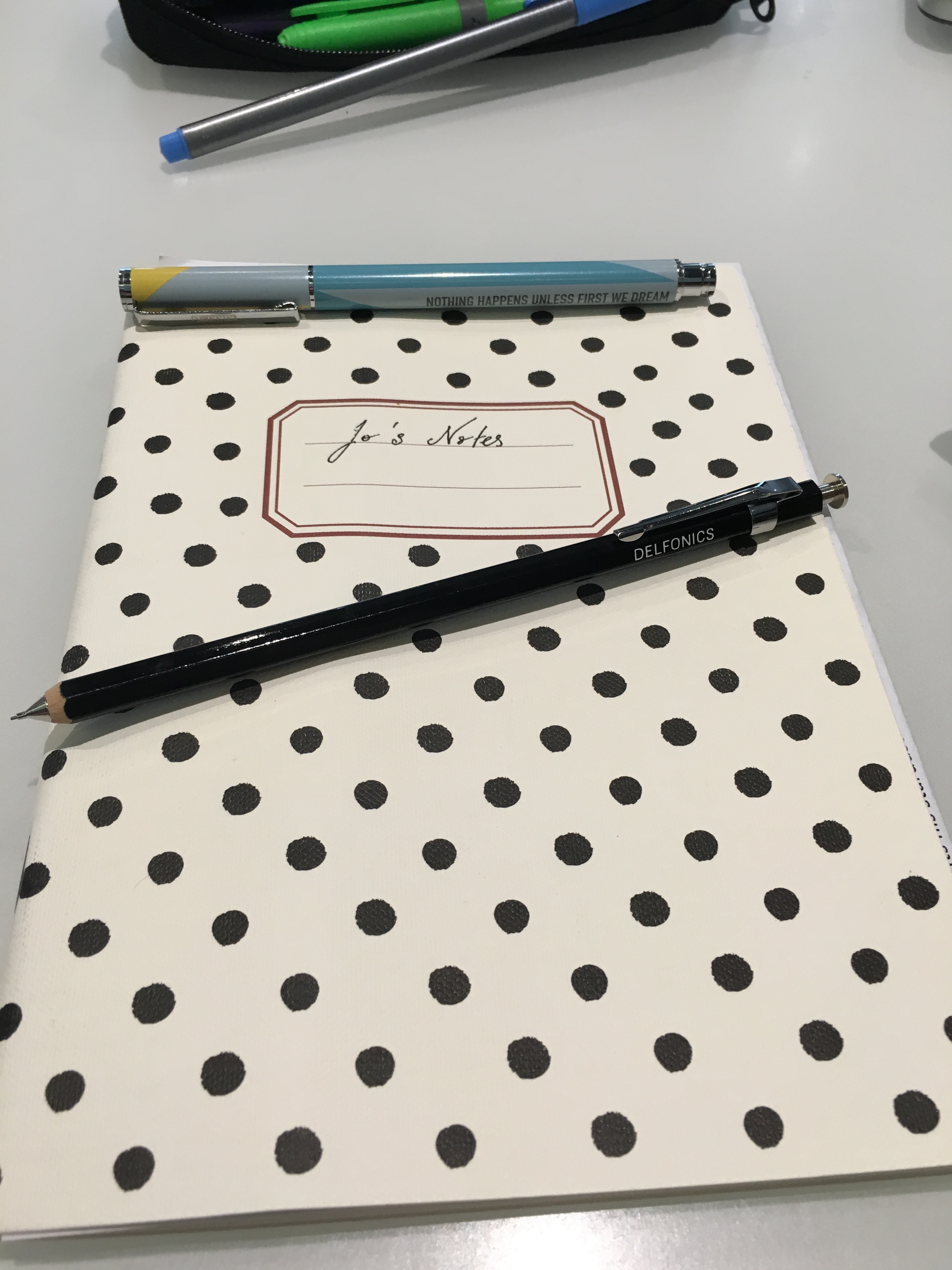
On a rainy day – the comforts of weather and writing

My day has begun with – what I consider to be – one of life’s pleasures: listening to rain fall against a window.

Being snuggled in bed with no immediate call on my time helped. Following it up with tea in my favourite mug and some vegemite toast that the dog was happy to share made it better. Now I’m watching clouds scud past the neighbours’ palm trees.

I’ll be honest, I don’t fully understand the love affair Perth has had with palm trees.

Jacarandas? Yes. Cape myrtles? Ok. Palm trees? Why?!

I know it’s probably just me.

I know I digress.

So, a rainy day in Perth at the end of a  busy, rainy week. The city continues to experience the below-average rainfall that we obsess about but there have still been  plenty of opportunities to listen to falling rain and run to cars through showers. There is more rain forecast for the week ahead.

My (purported) excess of umbrellas has been vindicated.

Progress with the scrawl

All in all, my project of working through the scrawl is coming along nicely. I’ve been fitting it in around various commitments and projects: the day-job …  a Cert IV I’m working towards … family.

This week I turned my attention to what my family refers to as Jo’s dead head, a gift from my sister for my 25th birthday. A bit tattered after nearly twenty years of abuse, the dead head has come in and out of my writing process. Using it in fits and and starts is no doubt what has helped it survive. I do not always treat it kindly.

Cloth covered journal
My ‘dead-head’ journal

There were notes in there from conferences in 2009 and a master class in 2013. I’ve typed and filed them at last. Scraps of ideas and lines of poetry have been sorted and culled as seemed necessary late into the night earlier this week. The recipes for Pineapple Chicken (yum) and Mrs Allen’s Chow Mein (not sure about that one) are still where they were. So are the reading lists I’ve been building up. At least the book is no longer bulging. It could take another refill.

After the clean-out, I have a couple of pieces that I think are worth working on. It is more likely that they will be worked on as I add them to the other bits and pieces that I’m pulling together as I work my way through the scrawl. Getting them out of the relative safety of the dead head means I can put them side by side with other remnants of the scrawl.

What to do with material liberated from the scrawl?

It is taking a while to work through everything. As well as dealing with the notebooks there are also far too many files that have needed to be cleared out. My shredder has come in handy.

My notes from a grad dip I didn’t finish (from 1992-1994)? Gone. My notes from staff meetings? Gone. I can almost see where I’ve been. My undergrad essays – desperately naive as they pretty much all are – all managed to make it back to their shelf. I expect their day will come.

If I had been more methodical, more systematic as I went along then I wouldn’t have this accumulation of writing debris. Perhaps. I could possibly still find myself needing to review and cull. I am sure that is the case.

Liberating material is necessary for a number of reasons. Here are four:

1. Space. There simply isn’t enough and I need to make some room. Imposing order and excavating material is part of establishing space.

2. Projects. I am working towards signing up for a PhD. I have a topic at hand, the forms are in … I’m just waiting for the next step. Sorting my environment is essential before I immerse myself in a six-year project.

3. Process. Working through the scrawl has been a part of my writing practice since … forever. Certainly around 1990 but I think I used to do this (on a smaller scale) when I was still in high school. I have a memory of a stenographer’s notepad from when I was in Year 9.  I called it a graffiti pad. It was angst-ridden and I loved it.

4. Retreat. Once it is all ‘done’ –  when I have pulled together the last bit from the scrawl and the files – I think a weekend of just the words pulled out from where they’ve been hiding and some fresh pages will do nicely as a treat. I’ve always ‘stockpiled’ notes and then written when I could pull together a reasonable chunk of time. Those chunks have been variously regular and scattered. A retreat is a chance to start afresh.

In the meantime, I’ve been making pretty good progress. I must nearly be there. If I’m lucky I’ll be able to listen to the rain as it falls while I work … and venture outside to splash in a puddle or two during breaks.

It sounds like bliss to me.
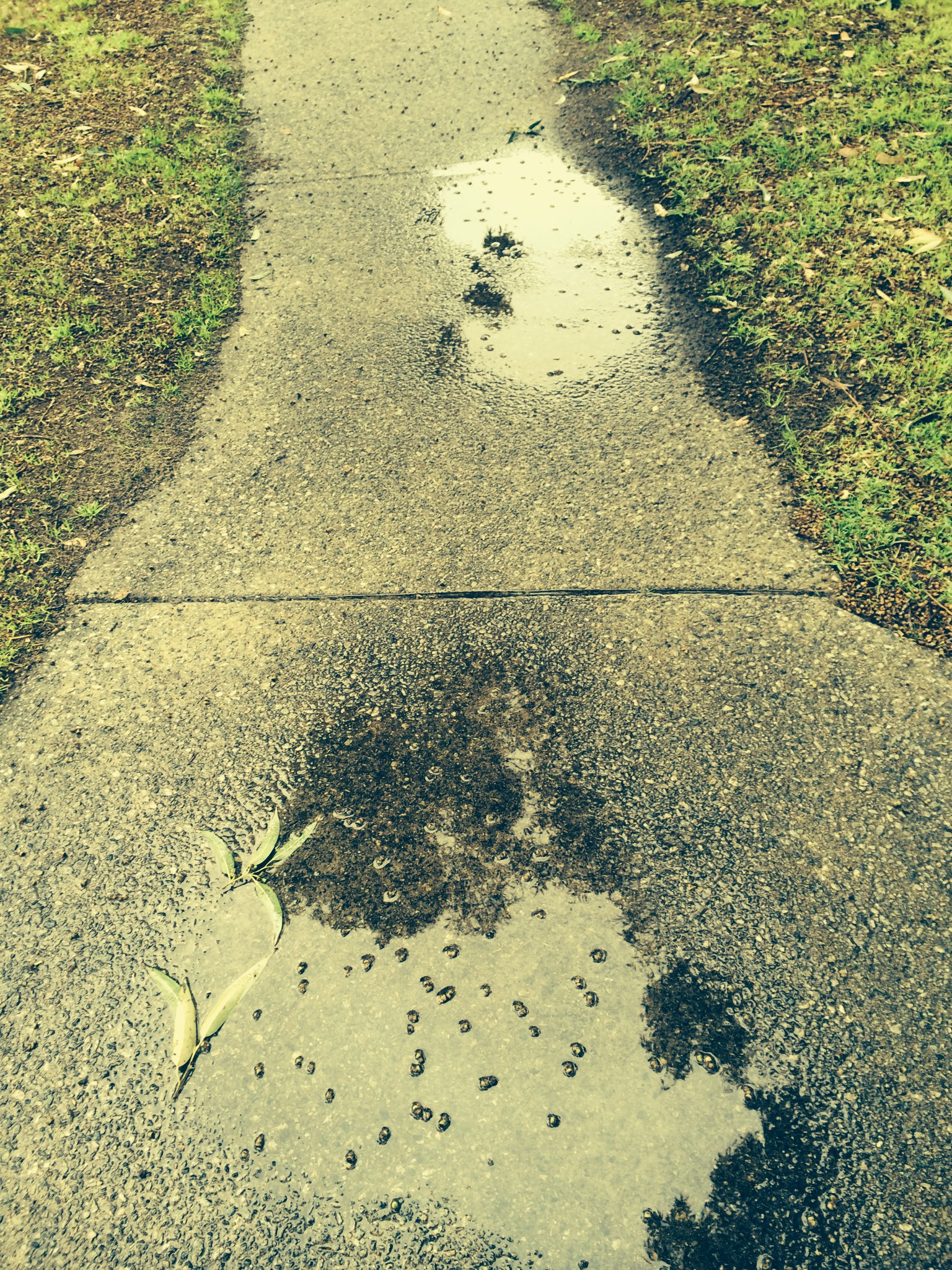
Two puddles on footpath in park
Puddles are a joy


On the fly – what happens when ideas slip away

I find myself at a loss. There is no excuse, really. I’m at Public and Co, in South Freo. It’s comfortable. The music is fun. As a found-space for writing, it is perfect.*

Yesterday, I knew precisely what I was going to write for today. It was a glorious day on campus. The sky was that blue you get on a warm, clear day in winter. The air was crisp. I remember the weather and where I was as I thought ‘yes, that’s it’ (I was passing the Oak Lawn on my way back to Arts before heading for the Club). The idea has evaporated.

The story of my life. Ideas come and go. If I’m lucky – i.e. sensible – I make a note. Often, I just get caught up. As I move on to the next thing I let go of an idea to take in something new.

So, here I am. My Saturday posting is a self-imposed and arbitrary deadline. It only matters because I’ve decided it does. There’s no other reason. Still, I need to meet it.

I remember the air was crisp.

Chaucer to Manson by way of Coleridge

Earlier this week, I found myself in front of a (thankfully small) group of strangers. I needed to give a presentation and I hadn’t prepared. There had been some confusion and I wasn’t sure I needed to … I should have. Being prepared is always helpful. I had said to my colleague that I would probably talk about poetry. When the moment came, poetry was what I latched onto.

I was lucky that I have been thinking so much about poetry of late. The other topics in my sights at the moment are women’s agency in late medieval and early modern English writing, impoverished knights and the experience and expression of shame – again late medieval, style guides and project plans. Looking at it, poetry was the friendly option.

I had tried a couple of times to make some notes. Nothing I came up with seemed to be at all promising. I had rehearsed some ideas – in a vague way, unable to settle on any form or content. I hadn’t written anything down.

In the flurry of the introduction and no knowing what I was going to talk about I launched into storytelling. I took my audience on a whirlwind ride. I remember I began with a joke – which I worried may have been inappropriate but couldn’t stop to check or apologise for – and I headed to Coleridge, his mariner and a funeral for a pen in a Literature class when I was in Year 11. I zipped backwards to Chaucer and I ended with Marilyn Manson.


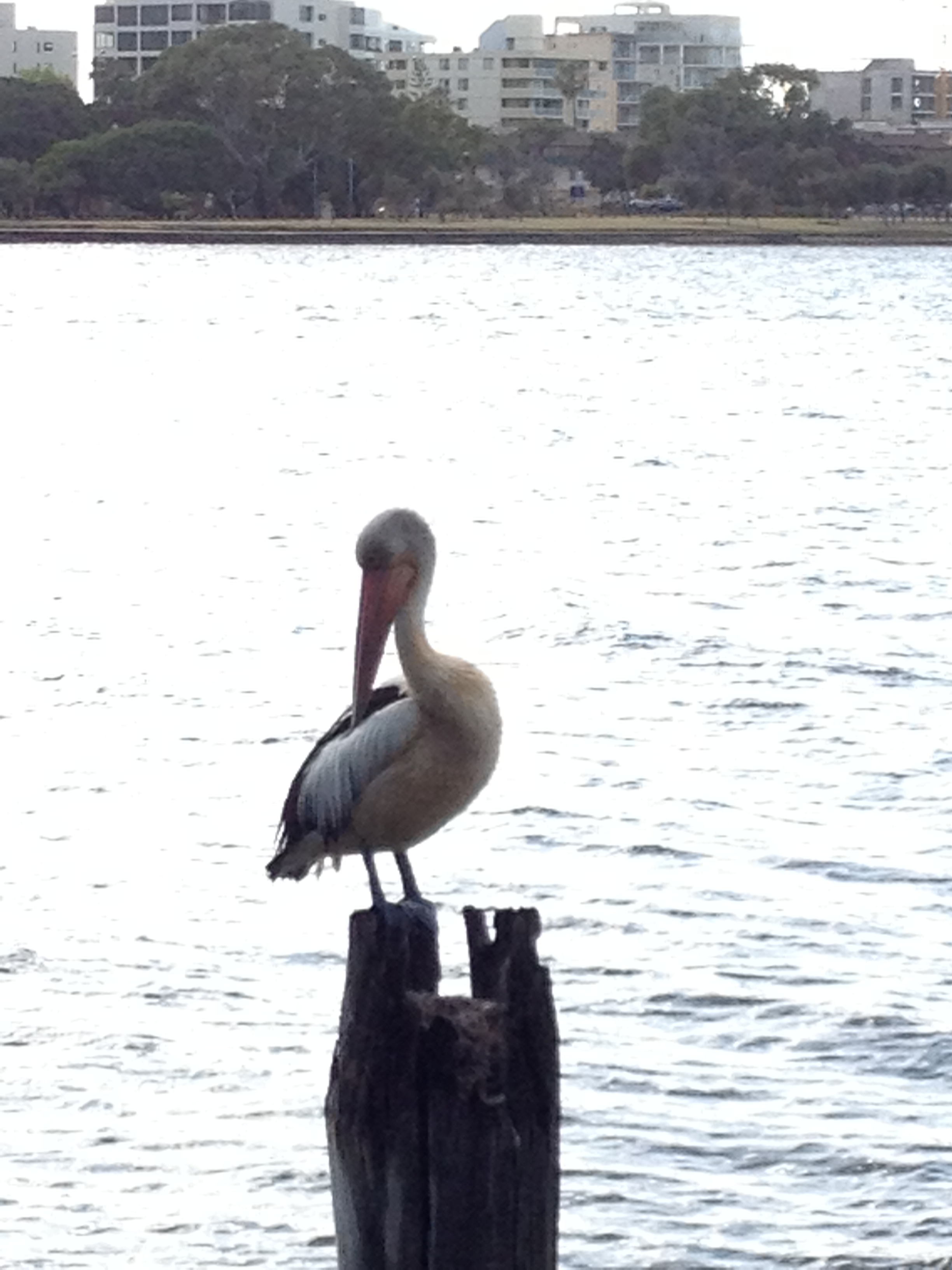
Pelican on jetty pylon
A standing pelican (in the absence of an airborne albatross)

I’m not entirely sure what I said – or how I got from one poet to the next – the whole thing  is a blur. I know I mentioned haiku and Ezra Pound couplets. I think I spoke for 5 minutes. I’m not sure what my time limit was.

I’ve told the funeral-for-a-pen story before, I’m pretty sure I know how that bit went.

Luckily, they laughed with me

I dread speaking in public. I used to speak quite a bit but I don’t do it that much these days. The further away I got from regular presentations, the scarier they became. It makes sense to me – more or less.

Apparently the talk this week went ok, though. While I can’t remember precisely what I said, I do remember that the audience laughed. I like it when that happens. Well, when an audience laughs with me. That’s quite nice.

The timer had flicked the panel of lights from green to amber. I knew the switch to red had to be on its way. I realised I wasn’t sure of the rules. Did I need to finish before the red? Was it ok to finish on the red? That’s the moment when I really began to panic. I was trying to find a way to finish off. That’s how Marilyn Manson got pulled into the whirlwind. It was a straw I happily grabbed at. It pulled everything together. I think. I trust.

It would be nice to remember what I actually said. It would be helpful to remember what the evaluator said. The words, like so many ideas, have evaporated.

I do remember that it felt good when the next person stood to speak.

The habit of over-thinking

So, where do these musings fit?

It’s not just that I’ve forgotten my initial idea. Nor that I mourn that it has escaped my grasp. I’m sure it will come back to me. At an inconvenient time. Probably the dead of night.

In the meantime, I have been thinking about the role over-thinking plays in my writing. There are areas where I think I just need to let some of go. While I don’t think unprepared talks are necessarily advisable, my Coleridge-Chaucer-Manson talk from this week probably worked because I just launched into it.

The imperative of getting to my feet and getting the words out meant that I got the talk done. Could it have been better? Probably. Would it have been better with drafting and rehearsal? Possibly.

Where it was tempting to over-think, not thinking (as such) seems to have had its merits. That’s something to think about.


*I have no intention of writing about food on this blog. It isn’t really my ‘thing.’ BUT … as I wrote this I indulged in an early lunch that took the form of a very late brunch … wild mushrooms done in sherry butter with really crispy bacon and toasted ciabatta. Wow.


A familiar dance – processing time is not always procrastination

My desk is tidy. Well, when I say ‘tidy’ I mean the half of the L-shape that is devoted to ‘technology’ is organised. I’ve washed and dried my hair. I’ve made my fingernails look a little less ragged. I’m about to finish my third mug of tea for the morning.

This is a dance I do. It would be quicker if, like the dog, I could just turn three circles, sit myself down and settle into the business of the day. For the dog that business is dozing. For me it is a to-do list.

This weekend’s general list includes emails, start week one of a mooc – before week two arrives, read articles for a research project, draft some notes for a talk I said I would give, complete essential chores, ignore non-essential chores, spend some time with family and friends, go for a walk  – preferably by the river where I’m confident there will be pelicans and I’m hopeful there will be dolphins.

Striking through

I do like crossing off items as they are done. It works for chores, projects, ideas that are acted on. I’ve been able to pull a couple of cards from my projects list in the past few weeks. They were among the smaller projects but it still feels good to have moved them to the ‘done pile’.

I also like to cross through titles in lists, verses in stanzas and paragraphs in prose. I can end up making a fair mess of any given page. For the most part, I’m comfortable with some untidiness on the page. There comes a point, though when too much mess becomes too fraught.

Making space

My mini-project of revising old notebooks – the scrawl I mentioned a couple of weeks ago – is in full swing. Putting sentiment to one side, some of the scrawl must give way. Space is at a premium.

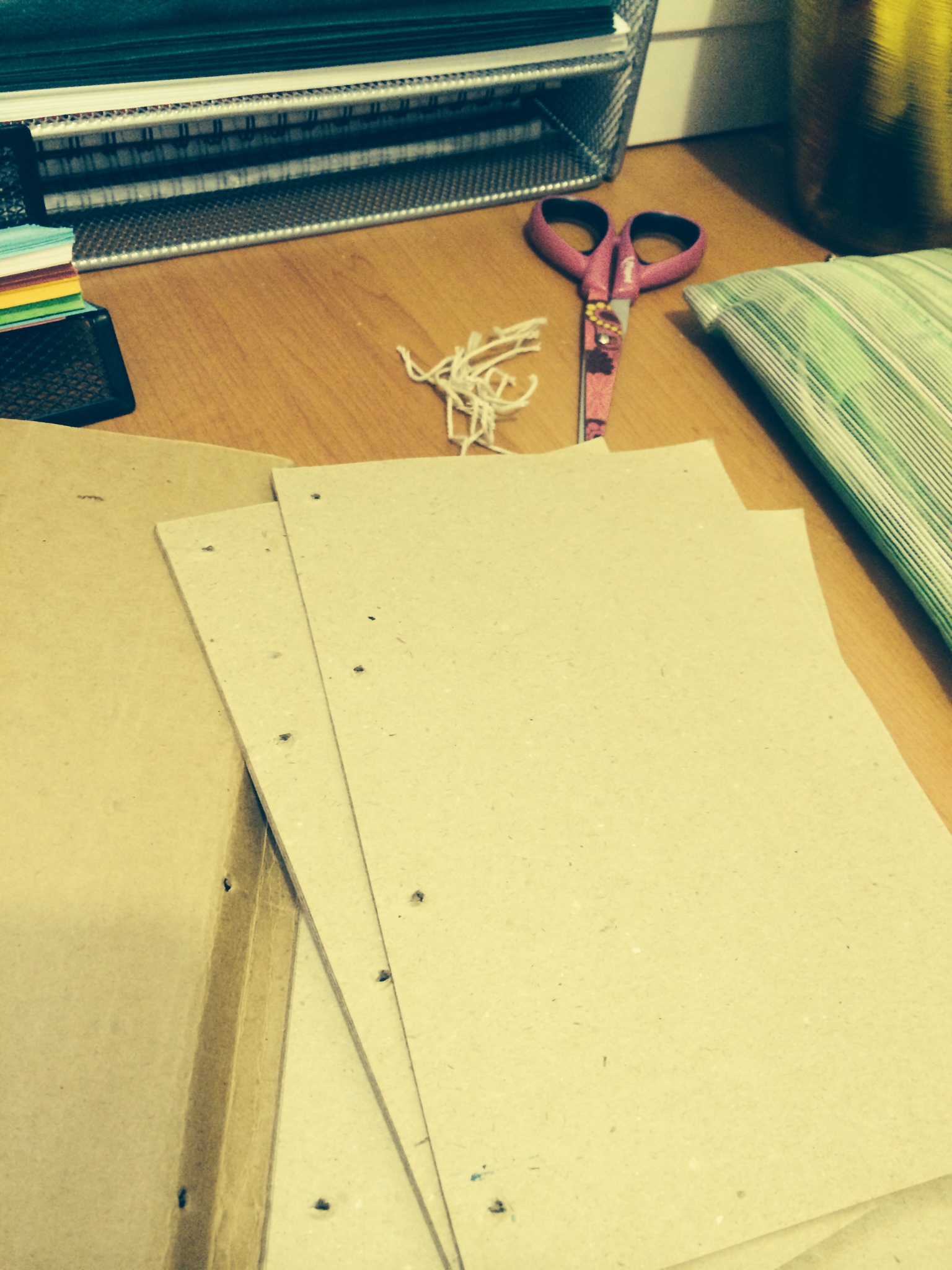
The focus of today’s attention was made of recycled paper bound with string in a corrugated card cover. I liked the book when it came to me, but it has its quirks. The threading on the spine makes it hard to keep open. The texture of the leaves entices. It promises more than struck-through notes and drafts. I’ve always been aware that I didn’t choose as wisely as I may have liked when I started out with it as a place for early workings.

One draft is dated ’98, so this book has been hanging about for a while. All but one of the notes in this particular notebook have been acted on. Most of the worked on pages have been folded to show they are finished. On balance, I have to admit not that many pages have been used. I’d like to start over with it. I think the remaining leaves can be repurposed.

Old notebook made of recycled paper with corrugated cover
Step 1: Initiate
struck through pages
Step 2: Check
ready for reuse
Step 3: Repurpose

Repurposing and renewing

My habit of making lists and roughing out brainstorms of ideas is a useful strategy. It makes for wonderfully productive days. This was especially the case when I worked as a teacher. I had a holiday routine that involved reviewing the lists and notes I’d made during term. If pieces of writing weren’t finished I’d work on drafts and commit to finishing things off. Not all holidays allowed for the routine to be evenly productive but there was certainly a rhythm to the process that helped it along.

I’ve had to modify the way I approach lists. Sometimes there is too much time between the note of the idea and the point of writing. Well, too much time in being up to pick up with the reason for making the note. Sometimes they just have to be repurposed. At at other times, the note is as vivid as when first written.

Looking through a poetry file today, I saw a poem I finished in 2001. It’s ok but not for sharing here. The point about the poem (‘Faithless’) is I first noted the opening line in my first year teaching. That was 1992. In the years between the note and the poem there was little shift in the intent of the idea I hoped to explore.

Other ideas and images need to sit for a while – steeping like tea – before they are ready for use. There’s nothing worse than tea left for so long it becomes bitter and unpalatable. That said, even stewed tea is good for the roses.*

A rueful acknowledgement

I can be quite precious about notebooks. I let them kick around for decades, long enough to end up looking tatty and disreputable. I don’t often attack them with scissors. This poor stablemate was doomed from day one. Happily, I think it has a promising future now it is free of its binding.

I’m sure the next notebook taken from the scrawl for review will fare better. In fact, I doubt many of the notebooks in the scrawl would do as well if I attempted to repurpose them.

*Ooh. There’s a poem there. What luck!

Poetry, memory and readiness – daily life and poetry

As I walked back to my car after last week’s symposium there was a kookaburra scrabbling for its dinner in the dirt under a tree. I stood for a while to watch. It was getting on for dusk and the campus was quiet. I was tired but happy. My head buzzed with ideas.

That brief moment watching the bird was calming. I took some time. I breathed.

I’m sure the memory of that moment will find its way into a poem at some point. I tend not to keep a journal as such but some (not all) of my writing contains snippets that are memories I want to keep. They are incidental – loading that word in a way I’ve not considered before.

It would be lovely if I had a photo to share of the kookaburra. Unfortunately, I don’t. (My phone – and therefore my camera – was in a bag of rice at the time.)

A week of poetry

Reading, writing and listening to poetry gives me joy. I think it is the play of words on the page and in the air.

Words were certainly in the air at Voicebox Fremantle on Monday night. Voicebox is a poetry performance event that comes around on the last Monday of the month. The format is generally three guest poets who read for about 20 minutes each.  Then there are about ten five-minute open mic spots that are slotted in around breaks. It’s a format that works well.

I don’t get to go as often as I would like. This time around I was feeling pretty tired with plenty to be working on after the symposium but I dragged myself to Freo. I’m so glad I did.

It turned out it was Voicebox’s birthday – and a year since the Voicebox performances moved to The Fly Trap, the side-bar at the Fly by Night .

The three guest poets for June were Allan Padget, Anne Elvey and Murray Jennings. I enjoyed each of their readings. I would happily listen to their poems again, and read them on the page. Elvey’s poems stood out for me, I think because of the way she was using some complex vocab in interesting ways. She’s reading again this afternoon – at the Perth Poetry Club – but I need to crack into some research and can’t make it.

Some of the open mic spots were particularly good. Anna Minska’s a capella performance of a new poem that ‘insists’ on being sung was outstanding. It mesmerised the audience. I was in awe of the poem and her performance.

After effects

The thing about going to events like Voicebox – even if I am just quietly sitting in the corner – is how they energise and connect.  I had felt so tired after work (and the busyness of the weekend) that I had considered not driving the half hour to get to Freo. At the end of the evening, I walked back to my car – this time well into the night – feeling calm and just that little less fatigued.

I’m back to filling the well really.

In the days that followed I reflected on the performances. I talked about them, and about writing. I also followed up on some poems from the symposium: Byron, Coleridge, Marvell. I thought about Keats for a bit.

Papers, notebooks and text
Bits of poetry taking shape

One of those conversations I had led to a request that I share some poems. I was reluctant but I found myself looking through my ‘finished’ poems. That, in turn, led to something of a mini-stocktake.

On taking stock

My heart sank a little when I saw the hard evidence that I haven’t had a lot of poems make it into a ‘finished’ pile in the last few years. I’ve done plenty of writing (thousands of words for uni, for example) but I’ve steered clear of the personal and the poetic.

That’s ok – it’s too bad if it’s not, to be honest. I’ve made choices and I’ve been aware of doing so as I’ve gone along and not committed to finishing poems. (I also haven’t finished other bits of writing. The poems are not alone in this.)

It strikes me, though, that this week’s stocktake went deeper than just flicking through. I wasn’t simply looking at what was there. I was looking for what I considered to be ready for sharing. It was material that I’ve shared before, why would it no longer be ready for sharing? The question seemed silly even as I thought about it.

I know that there has to come a point where I draw a line under a piece of writing (again, it’s not just the poems) and say ‘enough, it’s done’.

Drawing a line

So, in the spirit of sharing and drawing a line, here’s a poem (from 2009) that I consciously wrote as a memory piece. When I was writing it I really enjoyed the idea I was playing with. I was at the window of a room at the back of the Art Gallery of WA, at the Á propos poetry conference. It might not be ‘ready’, but here it is…

Falling

At the window
a tree lets loose
its blooms

To rain soft white
in overcast
morning

Autumn coming
a touch ahead
of time.

This brief prelude
heralding the
season.

Filling the well – inspiration, creativity and productivity

The idea of ‘filling the well’ is one of the best things that I took away from working through Julia Cameron’s The Artist’s Way (Pan, 1994).

It is years since I worked through the book. I remember making myself all sorts of commitments at the time. The one that has stayed with me is ‘filling the well’. If I’m drawing from the well then I need to make sure it isn’t going to run dry. I also need to make sure I can get to it. That’s pretty obvious. It makes sense.

Part of me would like to hunt out the notebook where I worked through Cameron’s exercises. I’ve no idea of where to begin to look for it now, though. It’s too long since I’ve seen it. There might be a chance that I jettisoned it in one of my (thankfully rare) I-must-not-hoard-this-clutter purges.

To be honest, I don’t need the notebook in my hand to remember what is in it. Especially for the ‘filling the well’ exercise. I know what, who and where I identified as keeping the well I draw from fresh.

Why am I thinking about it now?

This has all come to mind because this is the week of the medieval and early modern studies symposium that I try to get to each year. Many of the topics are often out of my direct area of expertise. Sometimes it’s hard to shift my schedule around, but it’s always worth the effort. It is one of the events that come up that I move my life around to be able to get to.

While most of my commitments from ‘the way’ have slipped into (fond) memory – morning pages and regular ‘artist dates’ used to be regular features of my creative life – making the time and space in my life to get to the symposium has stayed.  It is part of my filling the well.

The symposium brings together a lot of the elements of the list I came up with for the exercise: what – medieval and early modern literature (and now history), where – there are some places which help me focus on getting down to work, the UWA campus (and the general area of the river and King’s Park)  is one, and  who – my original list included individuals but also acknowledged how being a part of a community of writers is important to me, the symposium reflects (and creates) a community of scholars and writers that I enjoy being a part of.

Invariably, my understandings are deepened or my awareness extended by the papers given and conversations had at the symposium. There will always be something new that I will want to look up, even if just to satisfy my curiosity or find a point of clarification. I find links to my work – academic and creative – that I would never have thought of or, if I did, would have come about much later. Sometimes I find that I walk away with a bunch of ideas and images that will end up in a poem or a story. It all makes me happy.

In the past couple of days I’ve had the good fortune to participate in a master class on chivalry and the first day of a symposium on emotions and warfare in writing in the medieval and early modern period. It’s all been fascinating. I’m looking forward to today’s programme – most of which will be completely new to me. There are some poems being discussed which I’ve looked at a bit in the past – Andrew Marvell’s ‘Upon Appleton House’ I’ve thought about but done nothing with, the Alliterative Morte Arthure I’ve dipped into – but the other papers look like new territory. I can’t wait.

Not in the least distracting

 A funny thing about the well

As I’ve been writing this a new idea has come to me for a spot of research (that I possibly should leave until later, because I already have a few projects on the go). I think I’d like to look at moments in medieval romances to see when knights ask for water. There are a couple I can think of where they stop in mid-fight to drink – or ask to be allowed to drink. I wonder how much work has already been done on that.

Perhaps there’s a poem/story that I want to work, too. But it will have to wait until later…

The flutter-by effect – reflecting on my writing process

Years ago, I called one of my sisters ‘grasshopper’ in response to a question. In turn she called me ‘butterfly’ and then at some point – I’d obviously been a little scattered and not as focussed as (she thought) I could have been – I became ‘flutter-by’. I like to think it is a term of endearment rather than frustration. Sometimes it is, often … I just know that it isn’t.

The thing is, I know that there is an element (a whole table of elements probably) of truth my being called ‘flutter-by’ by my nearest and dearest.

malachite butterfly
Beautifully ragged … I hope it can fly

Is there a (fun) collective term for notebooks?

I quite like collective nouns. I love that you could have a rabble or a kaleidoscope or rainbow of butterflies. I’ve lived in a town where there was more or less a plague of butterflies for the first few weeks I was there. They were certainly a rabble.

(I won’t go into the plague of cockroaches that followed a few months latter. It is the stuff of nightmares. By the by, the collective noun for roaches is intrusion. That’s just about as perfect as you can get.)

When I tidied my desk last weekend I was struck by the sheer number of notebooks that had accumulated. There were stacks. It’s the right collective noun, but it just isn’t fun.

Perhaps I could suggest a drafting of notebooks or even a scrawl of notebooks? I’m actually prepared to just go it alone and start referring to having a scrawl of notebooks. – I’m sure collective nouns are still collective nouns if there’s just the one person who uses a particular term as the collective?

Flicking through some of the scrawl, I realised that I’m certainly prepared for any paper shortage that might hit suburban Perth. I also realised I have a plenty of work that I need to review, edit and commit to settling on as being finished. To be honest, I knew this already. Having the work in and out of my hands just made it real.

The work I need to complete ranges from poems and short stories to a couple of articles and reviews that I meant to finish months ago. I have – in short – been as blithe as my ‘flutter-by’ moniker would suggest. In fact, the  fifth sense of the OED (online) entry on blithe cuts a shade deep. (I suppose that’s the risk you run when you decide to do a quick check of the appropriateness of a word before you commit to it. I was more on the money than I first thought.)

New deadlines come in all the time …

In the end, I had to corral the notebooks into boxes. My plan is to work through each box systematically to review and sort the contents. My hope is that by ‘dealing with’ grouped units of books – one book at a time – I will be more effective than trying to sort the whole lot at once. It will also ensure I don’t fritter too much time away at the expense of work that I know I need to be doing now.

The danger – of course – is that it will now be the boxes that multiply exponentially.

Escaping the pinboard

In the end, what I know I need – as an inveterate flutter-by – is, I hesitate to say, pin myself down. But that seems a shade too violent, and not a lot of fun. So, I’m hoping that my approach to my writing/editing to-do list will help.

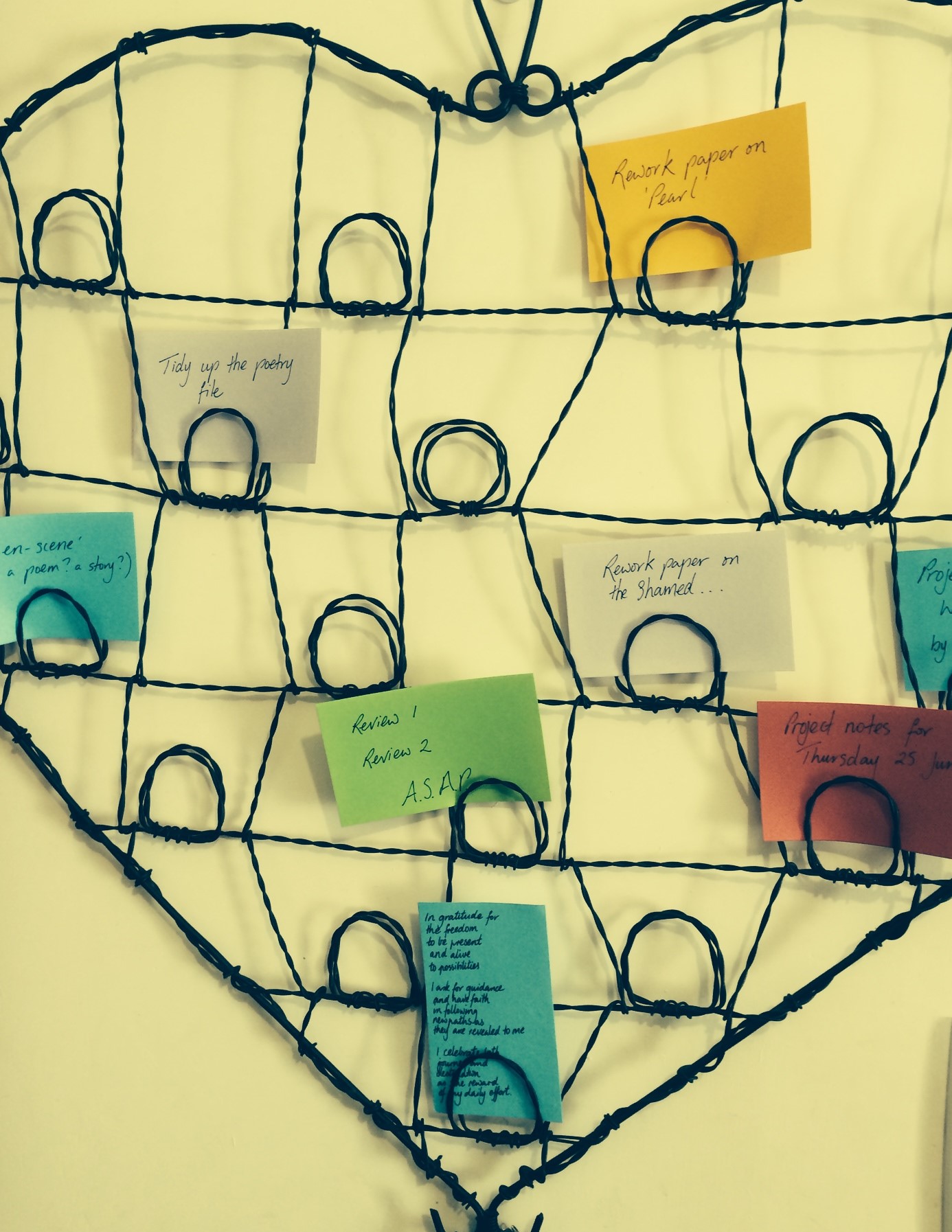
In no particular order ... but that red card looks urgent
In no particular order … but that red card looks urgent

Image of butterfly from mcamcamca

Starting out – the first step

I’ve been thinking about writing, and writing about thinking (not to mention thinking without writing, writing without thinking) for longer than I can remember. I thought it might be nice to do some of that out loud. In the sense that posting static text to a screen might be out loud.

So, here I am, on a sunny but cold day in Perth diving into the blogosphere with a space where I plan to write and think out loud about topics that might range from fourteenth century England to modern day Australia.


notebook and pencil
All I need