A trio of lectures – feeding my mind, filling the well

Deadlines are coming at me from all directions. They’re flying in thick and fast … and there’s no dodging them.

I’ve been a touch frantic in the past week. This, perhaps, explains how a whole mug of tea ended up on the study rug rather than by the computer. Perhaps.

As I’m not known for my coordination, it is possible the rather promising brew was always doomed.

The present collision of deadlines is unusual.

I am no stranger to the intersection of a few due dates but the current fortnight is a doozy.

My response? Set-up to-do list, remember that fretting about timelines makes me tetchy (sorry, loved ones), catch up with friends, remember to enjoy the sunshine and fresh air, sit on a couch by the window in a favourite cafe and write while waiting for an appointment,* take in a few lectures.
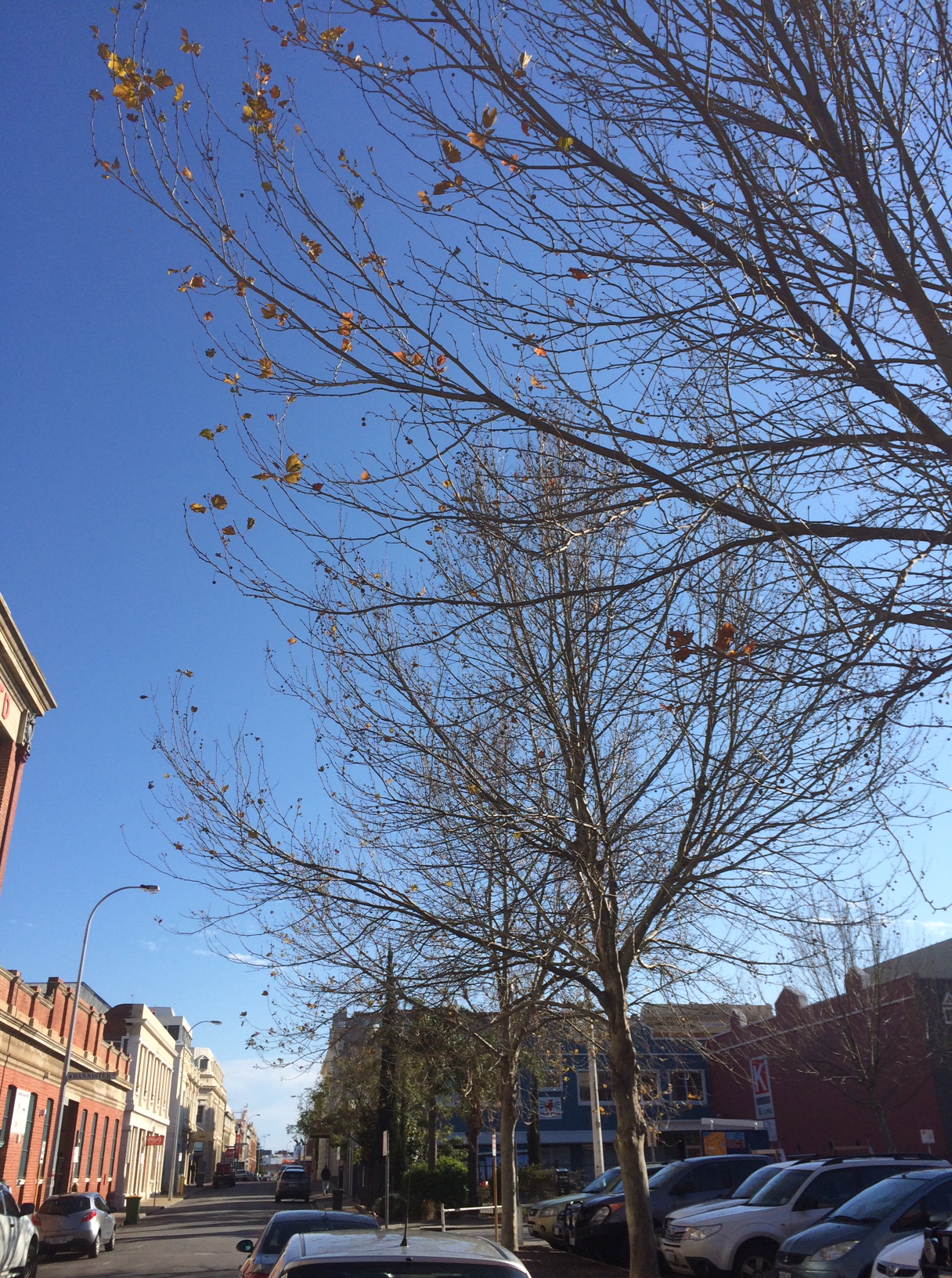
Pakenham St trees
Remembering to enjoy the sunshine

Why? Breaks that require me to stay alert and give time for reflection and planning are more helpful than simply ‘switching off”.

I find that if I choose television as a break activity I struggle to get back to working effectively. Engaging with other people and ideas creates space between one set of tasks and the next. So does the processing time that driving across town allows. I gather I’m not alone with this.

The bonus: once I’m on campus I find I am ready to focus and I tend to be quite productive. I think I’ve made that observation previously.

It was tricky, but I made it to three lectures this week. I’m glad I did.

The Bodleian and the First Folio of Shakespeare’s plays

Wednesday was Pip Willcox’s talk for UWA’s Institute of Advanced Studies: ‘for Harry, England, and … everyone: the many lives of the Bodleian First Folio of Shakespeare’s plays’. Pip Willcox is Curator of Digital Special Collections at the Bodleian Libraries, University of Oxford. She gave an account of the Bodleian’s ownership of a specific copy of the book, the physical features of the book, and the project to digitise the Folio.

It’s probably no surprise that I’m a book geek. I find the history of books as objects – and the history and process of creating books – fascinating.  I wanted to make it to the lecture as soon as I saw the abstract. The story of this particular copy has drama and intrigue. I wish I had time to go into the details.

The digitised product Willcox was speaking about looks to be a wonderful resource. The project website is still available at http://shakespeare.bodleian.ox.ac.uk and the digitised version of the folio is available at http://firstfolio.bodleian.ox.ac.uk. I can’t wait to have some free time to get in and look around properly.

Bresnick on Blake, Goya and Kafka

Thursday brought another presentation sponsored by the IAS featuring the composer Martin Bresnick, Professor of Composition, Yale School of Music. The title of the talk was ‘Listening to Images, Hearing the Text: new music that engages the visual and the literary’.

Bresnick spoke about his work as a composer – particularly in relation to the development of his multimedia piece developed from ‘For The Sexes: the Gates of Paradise’ by  William Blake and his response to Francesco de Goya’s ‘Caprichos Enfaticos’.

The evening included a live performance of ‘For the Sexes: the Gates of Paradise’ by Lisa Moore. The combination of music, spoken word and a projected animation of Blake’s illustrations of the poem was intense and visceral. It left me wanting to go back to Blake and read more by and about him. I’ll also look out for an online version of the multimedia piece. Not just yet, though. I need time and space for that.

The recorded  extracts from ‘Caprichos Enfaticos’ were powerful, and disturbing. Again, I want to go back to look at the full piece. That will definitely be down the track.

There wasn’t time for a performance of the third billed piece, on Franz Kafka’s ‘A Message from the Emperor’ but Bresnick’s account of the piece was intriguing. Something else to look into … again, at a later date.

Qaisra Shahraz on Building Bridges

The final lecture in the trio was an author talk by Qaisra Shahraz on ‘Building Cultural Bridges through Literature’ that was sponsored by the UWA Centre for Muslim States and Societies.

Shahraz moved to Britain from Pakistan when she was nine. She writes novels and has a commitment to building bridges, using literature to celebrate diversity. Identifying as as British, Pakistani and Muslim, Shahraz spoke about how each of these identities is important to her as a person and a writer. Reading from her novels, she shared a world that is alien and familiar.

This third talk came as a welcome change of pace. Making the dash from work to uni didn’t appeal and I was tempted to cut my losses and head home. I’m glad I braved the freeway at peak hour.

I walked away with a copy of her first novel. I’m afraid it will linger on my shelf before I get a chance to read it. I will want to take time and not be distracted by other things.

Even if I’m tempted … I must resist for at least the next few weeks!


Playgound
I need time to play

*The window in question for this particular post was at Bread in Common. On Saturday morning the sun was streaming in, the sky was clear. It was perfect for writing and working out a plan of attack for the weekend and the week ahead.

 

On a rainy day – the comforts of weather and writing

My day has begun with – what I consider to be – one of life’s pleasures: listening to rain fall against a window.

Being snuggled in bed with no immediate call on my time helped. Following it up with tea in my favourite mug and some vegemite toast that the dog was happy to share made it better. Now I’m watching clouds scud past the neighbours’ palm trees.

I’ll be honest, I don’t fully understand the love affair Perth has had with palm trees.

Jacarandas? Yes. Cape myrtles? Ok. Palm trees? Why?!

I know it’s probably just me.

I know I digress.

So, a rainy day in Perth at the end of a  busy, rainy week. The city continues to experience the below-average rainfall that we obsess about but there have still been  plenty of opportunities to listen to falling rain and run to cars through showers. There is more rain forecast for the week ahead.

My (purported) excess of umbrellas has been vindicated.

Progress with the scrawl

All in all, my project of working through the scrawl is coming along nicely. I’ve been fitting it in around various commitments and projects: the day-job …  a Cert IV I’m working towards … family.

This week I turned my attention to what my family refers to as Jo’s dead head, a gift from my sister for my 25th birthday. A bit tattered after nearly twenty years of abuse, the dead head has come in and out of my writing process. Using it in fits and and starts is no doubt what has helped it survive. I do not always treat it kindly.

Cloth covered journal
My ‘dead-head’ journal

There were notes in there from conferences in 2009 and a master class in 2013. I’ve typed and filed them at last. Scraps of ideas and lines of poetry have been sorted and culled as seemed necessary late into the night earlier this week. The recipes for Pineapple Chicken (yum) and Mrs Allen’s Chow Mein (not sure about that one) are still where they were. So are the reading lists I’ve been building up. At least the book is no longer bulging. It could take another refill.

After the clean-out, I have a couple of pieces that I think are worth working on. It is more likely that they will be worked on as I add them to the other bits and pieces that I’m pulling together as I work my way through the scrawl. Getting them out of the relative safety of the dead head means I can put them side by side with other remnants of the scrawl.

What to do with material liberated from the scrawl?

It is taking a while to work through everything. As well as dealing with the notebooks there are also far too many files that have needed to be cleared out. My shredder has come in handy.

My notes from a grad dip I didn’t finish (from 1992-1994)? Gone. My notes from staff meetings? Gone. I can almost see where I’ve been. My undergrad essays – desperately naive as they pretty much all are – all managed to make it back to their shelf. I expect their day will come.

If I had been more methodical, more systematic as I went along then I wouldn’t have this accumulation of writing debris. Perhaps. I could possibly still find myself needing to review and cull. I am sure that is the case.

Liberating material is necessary for a number of reasons. Here are four:

1. Space. There simply isn’t enough and I need to make some room. Imposing order and excavating material is part of establishing space.

2. Projects. I am working towards signing up for a PhD. I have a topic at hand, the forms are in … I’m just waiting for the next step. Sorting my environment is essential before I immerse myself in a six-year project.

3. Process. Working through the scrawl has been a part of my writing practice since … forever. Certainly around 1990 but I think I used to do this (on a smaller scale) when I was still in high school. I have a memory of a stenographer’s notepad from when I was in Year 9.  I called it a graffiti pad. It was angst-ridden and I loved it.

4. Retreat. Once it is all ‘done’ –  when I have pulled together the last bit from the scrawl and the files – I think a weekend of just the words pulled out from where they’ve been hiding and some fresh pages will do nicely as a treat. I’ve always ‘stockpiled’ notes and then written when I could pull together a reasonable chunk of time. Those chunks have been variously regular and scattered. A retreat is a chance to start afresh.

In the meantime, I’ve been making pretty good progress. I must nearly be there. If I’m lucky I’ll be able to listen to the rain as it falls while I work … and venture outside to splash in a puddle or two during breaks.

It sounds like bliss to me.

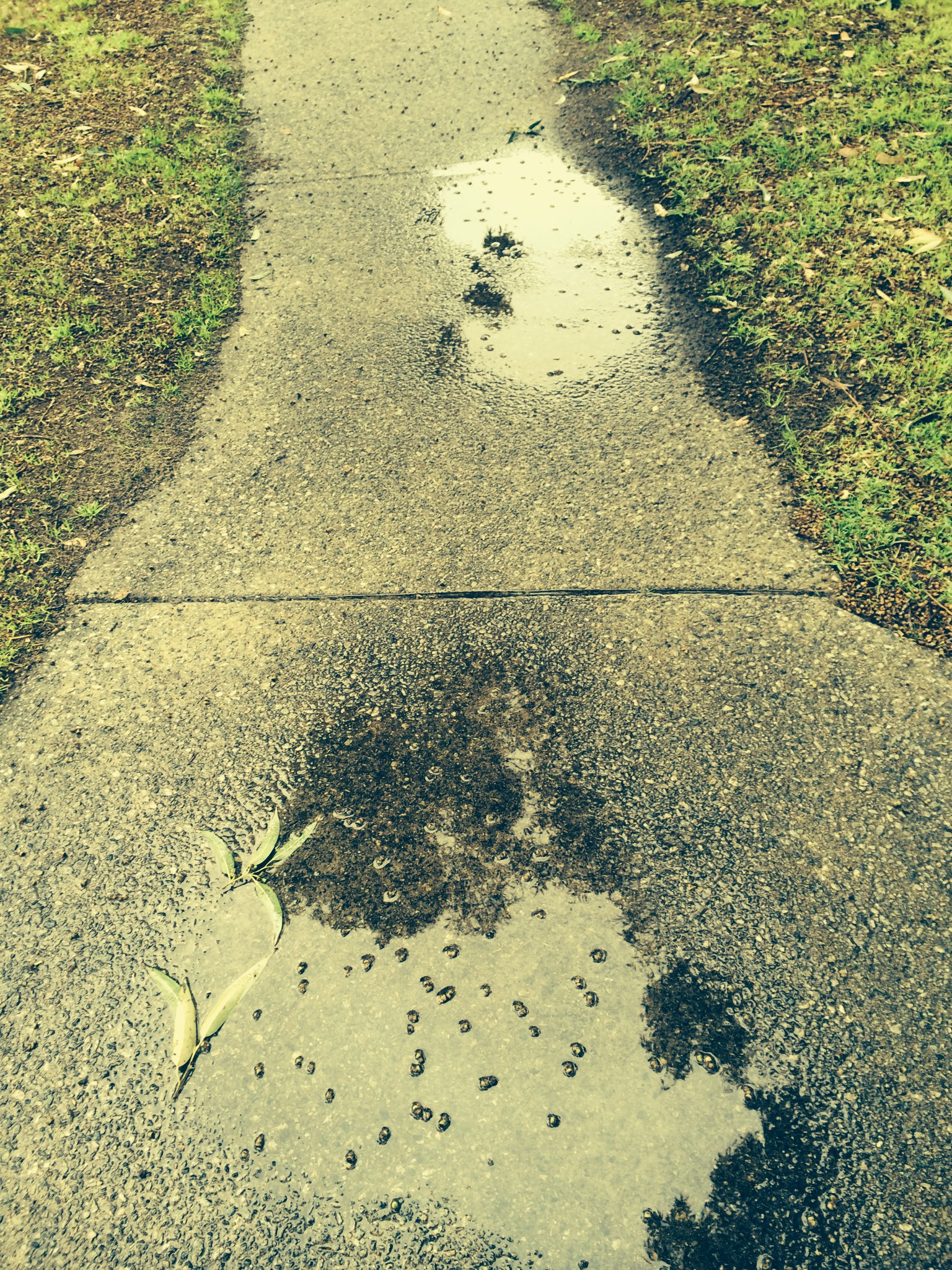
Two puddles on footpath in park
Puddles are a joy


A familiar dance – processing time is not always procrastination

My desk is tidy. Well, when I say ‘tidy’ I mean the half of the L-shape that is devoted to ‘technology’ is organised. I’ve washed and dried my hair. I’ve made my fingernails look a little less ragged. I’m about to finish my third mug of tea for the morning.

This is a dance I do. It would be quicker if, like the dog, I could just turn three circles, sit myself down and settle into the business of the day. For the dog that business is dozing. For me it is a to-do list.

This weekend’s general list includes emails, start week one of a mooc – before week two arrives, read articles for a research project, draft some notes for a talk I said I would give, complete essential chores, ignore non-essential chores, spend some time with family and friends, go for a walk  – preferably by the river where I’m confident there will be pelicans and I’m hopeful there will be dolphins.

Striking through

I do like crossing off items as they are done. It works for chores, projects, ideas that are acted on. I’ve been able to pull a couple of cards from my projects list in the past few weeks. They were among the smaller projects but it still feels good to have moved them to the ‘done pile’.

I also like to cross through titles in lists, verses in stanzas and paragraphs in prose. I can end up making a fair mess of any given page. For the most part, I’m comfortable with some untidiness on the page. There comes a point, though when too much mess becomes too fraught.

Making space

My mini-project of revising old notebooks – the scrawl I mentioned a couple of weeks ago – is in full swing. Putting sentiment to one side, some of the scrawl must give way. Space is at a premium.

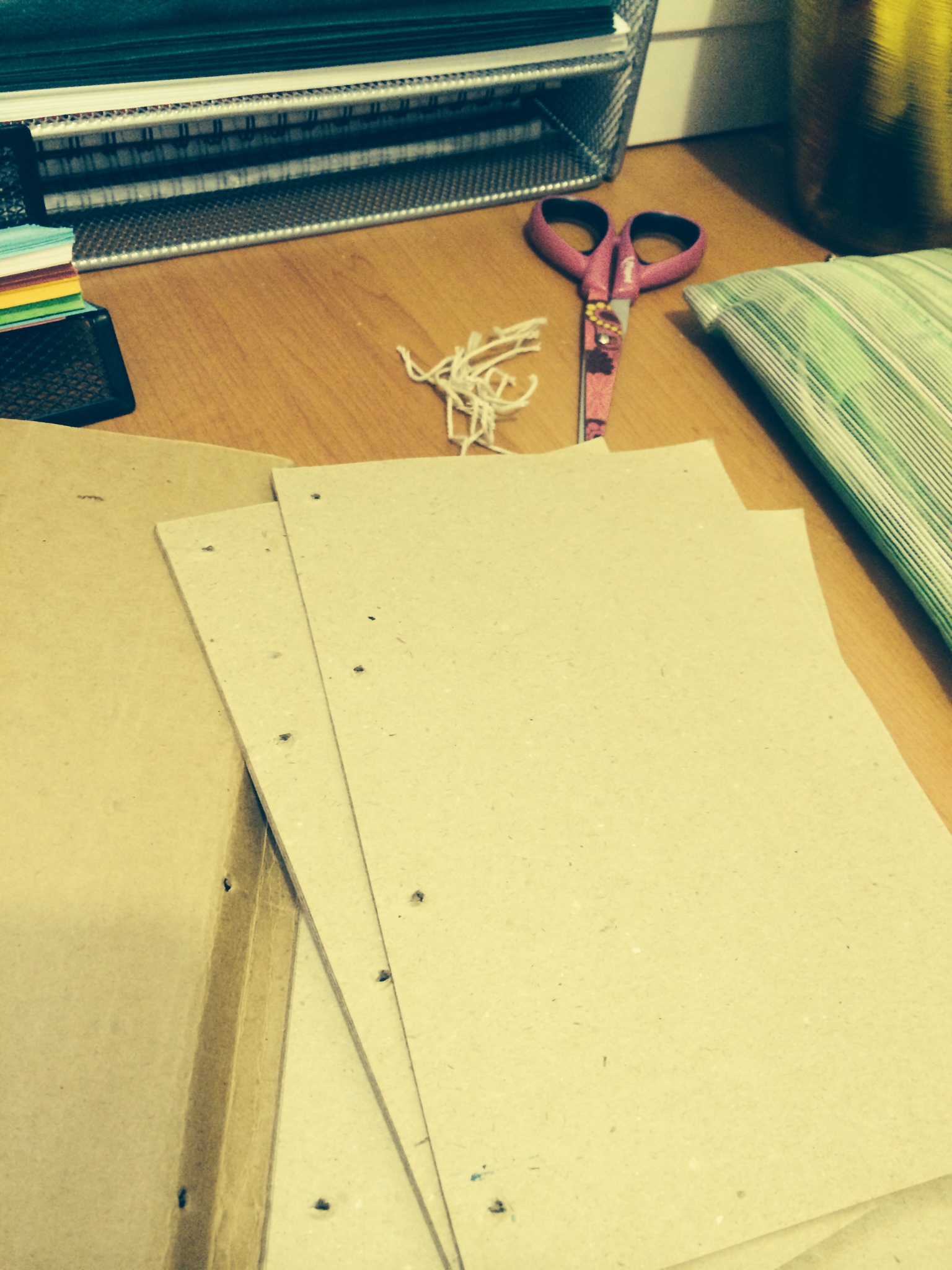
The focus of today’s attention was made of recycled paper bound with string in a corrugated card cover. I liked the book when it came to me, but it has its quirks. The threading on the spine makes it hard to keep open. The texture of the leaves entices. It promises more than struck-through notes and drafts. I’ve always been aware that I didn’t choose as wisely as I may have liked when I started out with it as a place for early workings.

One draft is dated ’98, so this book has been hanging about for a while. All but one of the notes in this particular notebook have been acted on. Most of the worked on pages have been folded to show they are finished. On balance, I have to admit not that many pages have been used. I’d like to start over with it. I think the remaining leaves can be repurposed.

Old notebook made of recycled paper with corrugated cover
Step 1: Initiate
struck through pages
Step 2: Check
ready for reuse
Step 3: Repurpose

Repurposing and renewing

My habit of making lists and roughing out brainstorms of ideas is a useful strategy. It makes for wonderfully productive days. This was especially the case when I worked as a teacher. I had a holiday routine that involved reviewing the lists and notes I’d made during term. If pieces of writing weren’t finished I’d work on drafts and commit to finishing things off. Not all holidays allowed for the routine to be evenly productive but there was certainly a rhythm to the process that helped it along.

I’ve had to modify the way I approach lists. Sometimes there is too much time between the note of the idea and the point of writing. Well, too much time in being up to pick up with the reason for making the note. Sometimes they just have to be repurposed. At at other times, the note is as vivid as when first written.

Looking through a poetry file today, I saw a poem I finished in 2001. It’s ok but not for sharing here. The point about the poem (‘Faithless’) is I first noted the opening line in my first year teaching. That was 1992. In the years between the note and the poem there was little shift in the intent of the idea I hoped to explore.

Other ideas and images need to sit for a while – steeping like tea – before they are ready for use. There’s nothing worse than tea left for so long it becomes bitter and unpalatable. That said, even stewed tea is good for the roses.*

A rueful acknowledgement

I can be quite precious about notebooks. I let them kick around for decades, long enough to end up looking tatty and disreputable. I don’t often attack them with scissors. This poor stablemate was doomed from day one. Happily, I think it has a promising future now it is free of its binding.

I’m sure the next notebook taken from the scrawl for review will fare better. In fact, I doubt many of the notebooks in the scrawl would do as well if I attempted to repurpose them.

*Ooh. There’s a poem there. What luck!

The flutter-by effect – reflecting on my writing process

Years ago, I called one of my sisters ‘grasshopper’ in response to a question. In turn she called me ‘butterfly’ and then at some point – I’d obviously been a little scattered and not as focussed as (she thought) I could have been – I became ‘flutter-by’. I like to think it is a term of endearment rather than frustration. Sometimes it is, often … I just know that it isn’t.

The thing is, I know that there is an element (a whole table of elements probably) of truth my being called ‘flutter-by’ by my nearest and dearest.

malachite butterfly
Beautifully ragged … I hope it can fly

Is there a (fun) collective term for notebooks?

I quite like collective nouns. I love that you could have a rabble or a kaleidoscope or rainbow of butterflies. I’ve lived in a town where there was more or less a plague of butterflies for the first few weeks I was there. They were certainly a rabble.

(I won’t go into the plague of cockroaches that followed a few months latter. It is the stuff of nightmares. By the by, the collective noun for roaches is intrusion. That’s just about as perfect as you can get.)

When I tidied my desk last weekend I was struck by the sheer number of notebooks that had accumulated. There were stacks. It’s the right collective noun, but it just isn’t fun.

Perhaps I could suggest a drafting of notebooks or even a scrawl of notebooks? I’m actually prepared to just go it alone and start referring to having a scrawl of notebooks. – I’m sure collective nouns are still collective nouns if there’s just the one person who uses a particular term as the collective?

Flicking through some of the scrawl, I realised that I’m certainly prepared for any paper shortage that might hit suburban Perth. I also realised I have a plenty of work that I need to review, edit and commit to settling on as being finished. To be honest, I knew this already. Having the work in and out of my hands just made it real.

The work I need to complete ranges from poems and short stories to a couple of articles and reviews that I meant to finish months ago. I have – in short – been as blithe as my ‘flutter-by’ moniker would suggest. In fact, the  fifth sense of the OED (online) entry on blithe cuts a shade deep. (I suppose that’s the risk you run when you decide to do a quick check of the appropriateness of a word before you commit to it. I was more on the money than I first thought.)

New deadlines come in all the time …

In the end, I had to corral the notebooks into boxes. My plan is to work through each box systematically to review and sort the contents. My hope is that by ‘dealing with’ grouped units of books – one book at a time – I will be more effective than trying to sort the whole lot at once. It will also ensure I don’t fritter too much time away at the expense of work that I know I need to be doing now.

The danger – of course – is that it will now be the boxes that multiply exponentially.

Escaping the pinboard

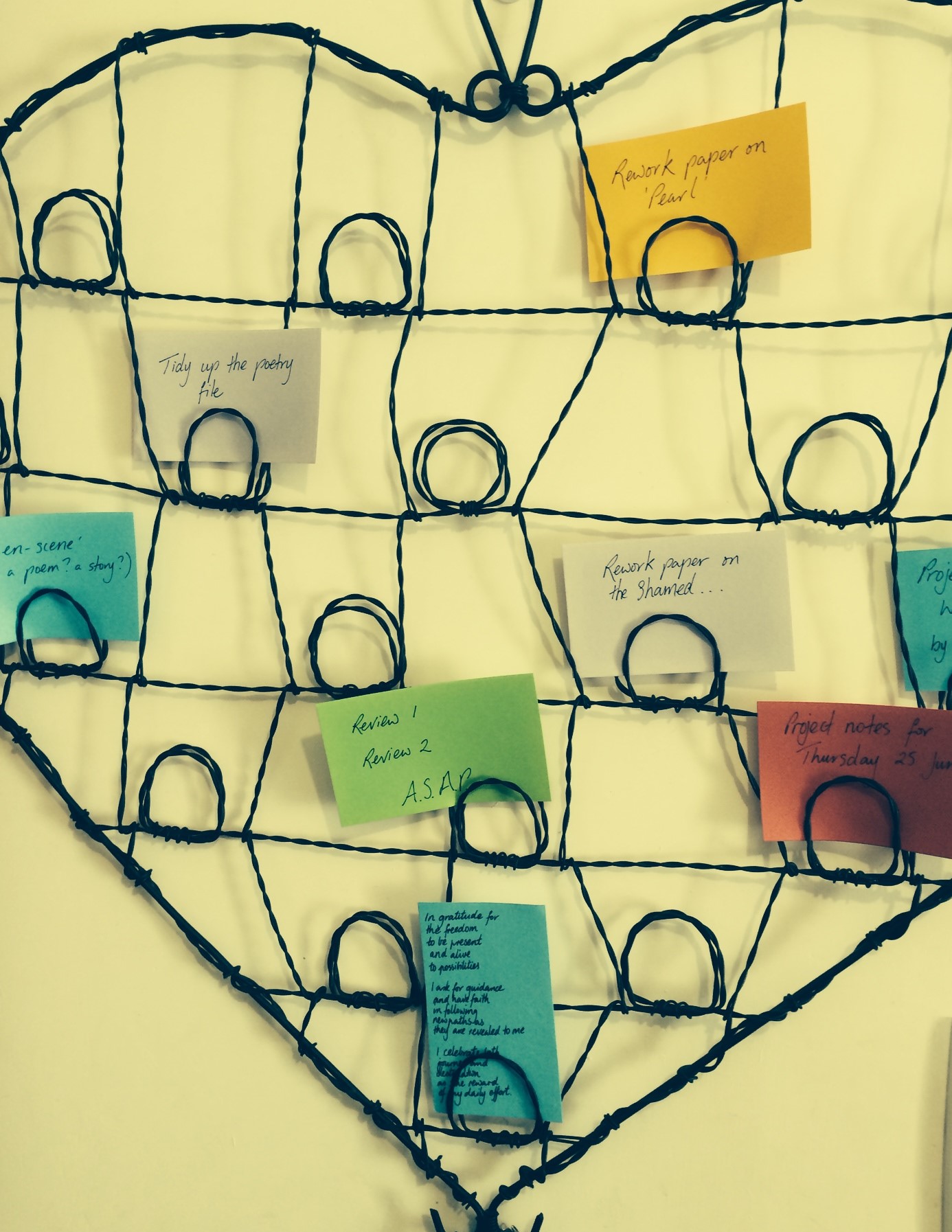
In the end, what I know I need – as an inveterate flutter-by – is, I hesitate to say, pin myself down. But that seems a shade too violent, and not a lot of fun. So, I’m hoping that my approach to my writing/editing to-do list will help.

In no particular order ... but that red card looks urgent
In no particular order … but that red card looks urgent

Image of butterfly from mcamcamca