Poetry in film – a quick update

I finally caught up with watching O Brother, Where Art Thou and loved it. I was blessed that a friend volunteered to watch it with me. She cooked chicken, I bought salad. (It is generally understood and accepted that if I’m bringing something for the table I’ll be picking it up on the way.) Sharing the viewing wasn’t something I had planned when I thought of this project.

With all the other reading I’ve had on the go lately, I hadn’t had time to review The Odyssey in the detail I would have liked. Instead, I resorted to rustling up some quick searches on my tablet as the DVD played. I figure that since I went through a phase of watching the movie a lot a few years ago (scenes and dialogue memorised, etc.) I wasn’t interfering with the viewing process.

Not too much, anyway.

On balance

I decided I really do like the looseness of the Coen brothers’ approach to the story. I’d also like to look at more interpretations and spin offs, but I know I just don’t have time. Perhaps when I’m next looking for a side-project it could just be about incarnations of epic poetry in popular culture.

The possibility of it feels so deliciously nerdy.

I can see my reading/viewing list already. I think it will begin with Margaret Atwood’s The Penelopiad (Canongate Myth Series, 2005).* The first film is likely to be 2001: A Space Odyssey (Kubrick, 1968) – because I can’t remember when I last watched it. Certainly not in living memory.

Abundance

I’ve also been thinking there might be a couple of poems of my own that I’d like to work on. (To be clear, I have NO plans to attempt epic poetry any time soon!) Not that I need to add anything more to the to-be-written list. That seems to have been exploding in the past little while. On the upside, I’ve managed to move some titles from the to-be-written to the that’ll-do-for-now side of the ledger.

Getting things written is always lovely.  I don’t mean that as a euphemism. I literally mean that I find finishing a piece of writing to be one of life’s pleasures. It is lovely.

In the meantime, there is a short story that I’ve been meaning to read again – ‘The Owl Boy and the Goddess Athene’ by Gillian Rubinstein. You’ll find it in Bizarre: Ten wonderfully weird stories, compiled by Penny Matthews (Omnibus Books, 1989). I used to love reading it to Year 8s. Such fun!

Reading wakes me up, so now – it’s gone midnight – isn’t my best time to open the book. I think it’ll be a goer for when the alarm goes off in the morning. So long as I get to sleep soon(ish).

Before I go

Next up on the poetry-in-film plan is

  • March Jabberwocky (Terry Gilliam, 1977)
  • April The Raven (I’m not sure which version … Charles Brabin, 1915; Louis Friedlander, 1935; Roger Corman, 1963; James McTeigue, 2012)

I think we can safely say, March is going to look a lot like April by the time I sit down to Jabberwocky and I still need to work out which version of The Raven … I’m a shade torn.
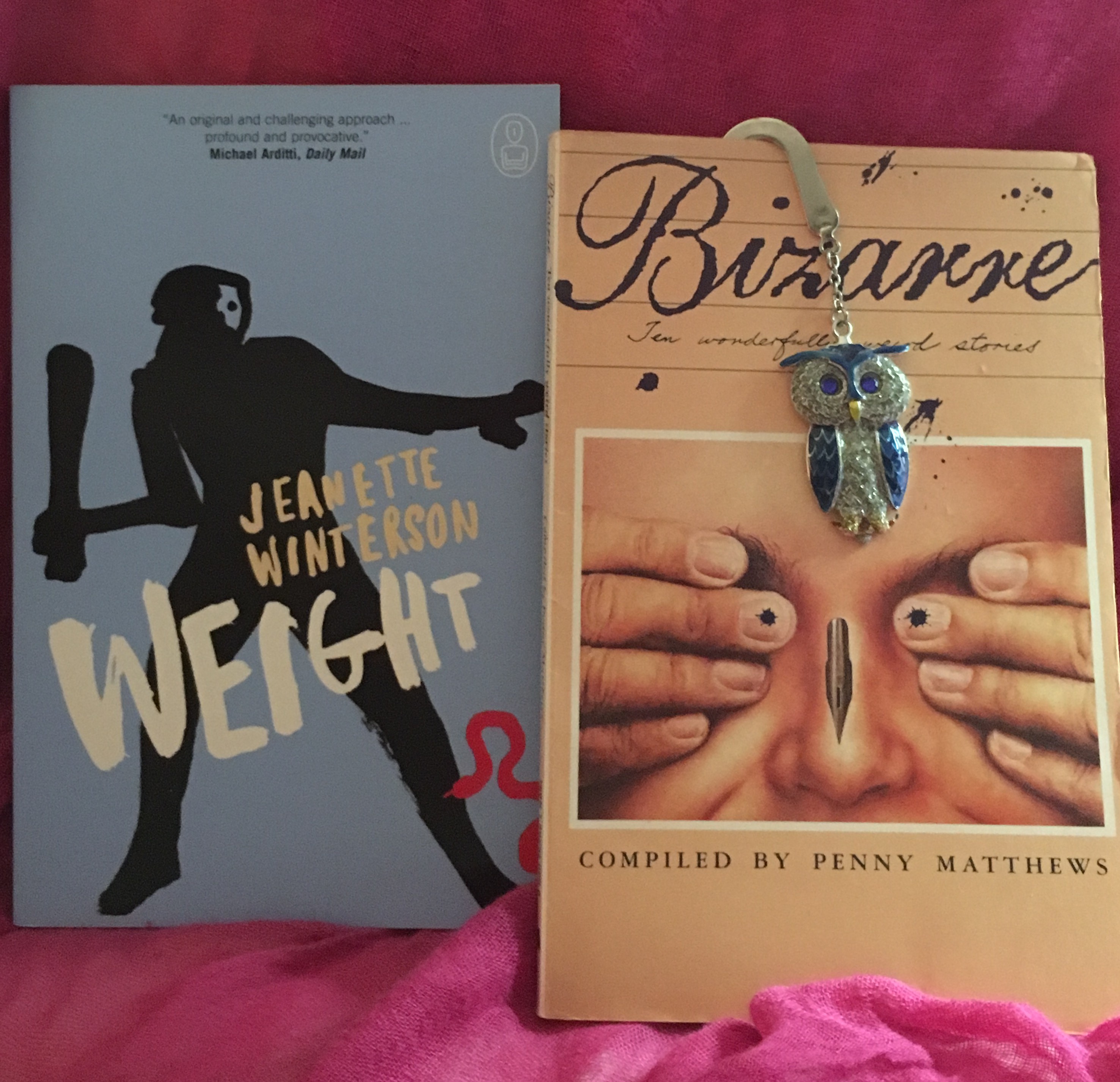
Twists on myth quick reads
A couple of quick reads for the meantime


*Jeanette Winterson’s Weight is a part of the Canongate Myth Series. I love it. I cry every time I read it – and I seem to read it every year or so.


Poetry in film – February – O Brother, Where Art Thou?

Yes. I know. It’s March. What happened to February? I still can’t believe it’s gone.

My plan for February was to watch O Brother, Where Art Thou?  by the Coen brothers. The DVD is ready and waiting on a shelf I pass multiple times a day. It’s at eye level and I look at it each time I pass by. I just haven’t been able to watch it.

Despite that, the film and its distant, loose connections to The Odyssey have been on my mind.

In the meantime, my real purpose in this ‘poetry in film’ project (which sounds so much better than distraction, tangent, avoidance strategy …) was to think about the poems. There should be time for the film over the Easter break but I’m going to jump ahead and riff a bit about the poem now.

A late arrival

I came to The Odyssey late. I dipped into it as necessary when I was an undergrad. I watched friends work with it as part of their studies of Ancient Greek. I wished I could fit Ancient Greek into my own program. I couldn’t. I let it go.

I have fond memories of Sunday mornings in the ’90s watching Tony Robinson’s Odysseus, The Greatest Hero of Them All. I loved that. Robinson’s storytelling on windswept beaches and that great grey coat (and was there a red scarf? a pinkish one?) has stayed with me. Rik Mayall’s Grim Tales was also part of my television viewing at this time. I remember there was cracking storytelling from both Robinson and Mayall.

From time to time there were brief excursions into episodes along the way. Links to a short story here, a conversation about Homer/epic poetry/oral traditions there. It would come up – as you’d expect – in discussions about the hero’s journey and archetypes.

I didn’t read the poem in full until I was in my thirties. I still haven’t learnt any Ancient Greek* so I read it in translation – a Penguin Classics edition by E. V. Rieu, D. C. H. Rieu and Peter Jones and the Robert Fagles translation that I’ve realised is missing from my bookshelf and will need to be replaced. (Yay for shiny new copies!)

I read the Rieu et al version at the height of summer, stretched out on the floor very close to a fan. It was perfect reading for ridiculously hot days that stretched into hideously hot weeks.

I loved the unevenness of the narrative line. When I finished The Odyssey I jumped straight to The Iliad. It was that sort of summer.

poetry in film check in february book pile
Ready and waiting

A recent encounter

In the past few months, The Odyssey has been popping up. It could be I’m noticing it because I knew I would be thinking about it as part of the schedule I set myself. One of those, I just bought a red car, now all I notice is red cars scenarios.

The most striking encounter was when I caught The Epic (Finn O’Branagain and Scott Sandwich) as part of this year’s Perth Fringe Festival. That was an hour of whirlwind storytelling that looked at some of the ‘big’ stories from across the world over history. The show included a captivating demonstration of the ripples of the story that continue to be felt. (I won’t go into detail because I’d hate to spoil it for you if you ever get to see it. You never know…)

I had gone to the show because I thought there was a bit about Macbeth (there wasn’t). The Odyssey turning up was a timely bonus.

The Muse and magic

The Odyssey opens with an invocation to the Muse. As it’s an epic poem, I’m guessing that is Calliope. The invocation rests in ritual and the sacred. It also makes sense for the poem as a spoken performance. It not only calls the muse but captures the audience.

The telling of the story begins with an incantation.

Perfect. So much of storytelling is weaving a spell. I love that drawing in – and being drawn in. There is also the appeal of an external (or it could be internal) driver.

The invocations in Homer’s The Odyssey, its companion The Iliad, Virgil’s The Aeneid and in later poems such as John Milton’s Paradise Lost and, with a slightly different  purpose, Edmund Spenser’s The Faerie Queene offer up the poem as something not only created but inspired.

The lit-nerd in me quite likes the idea of reading just the invocations and doing a formal comparison of what they seek and what they offer.

There are all sorts of arguments against inspiration and for the hard graft of day in-day out work, but there’s a part of me that loves the idea of an otherworldly – if not divine (and these days I’m more atheist than agnostic …) – spark as the impetus of a work.

Why not begin with an invocation to a muse, human, divine or otherwise?

Peacock close up
A muse of sorts

*One day I hope to read it in the Ancient Greek. For now, though, translations have to do. After this thesis is done. Latin has a higher priority. And Middle English, for that matter. I’ll be in my 50s. Excuse me while I process that …

Paper trails, paper trials – a meditation on why notebooks are important

Summer has been an on-again, off-again affair so far and now Perth is at the start of a heatwave. In these past couple of days, I feel I’ve been crisping and melting by turns.

The blessing of hot days in Perth is the sea breeze that tends to arrive in the afternoon. The heat doesn’t always seep away with nightfall, but days often end with some relief. On Friday evening there was time with family by the river with the bonus of dolphins. This morning I planted myself in front of a fan while I sorted papers and the general clutter of desks.

Colours and patterns

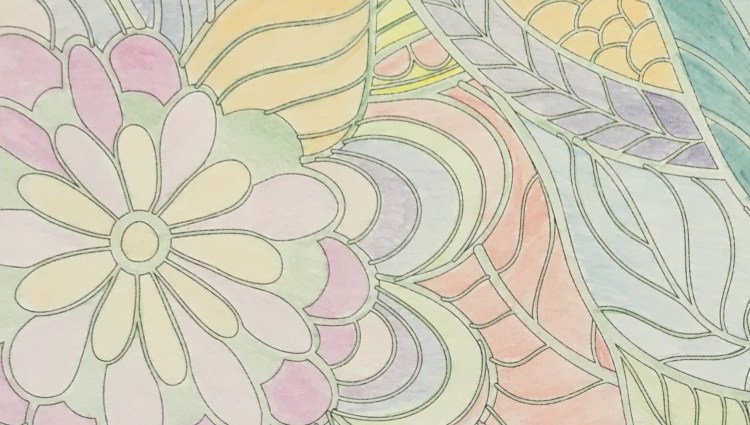
While I was sticking close to the fan I took some time out to do some colouring in. This might seem like a small thing. Kids colour in. How hard can it be?

heatwave colouring
Cool mindfulness

The current craze with adult colouring in promotes the potential for colouring in to promote mindfulness, to be meditative. I have a chequered history with colouring in. I’m not sure how relaxing it is.

I remember being in Year 1 and the first line of most pages being given over to making patterns. I wanted my workbooks to be beautiful, my patterns to be perfect. Spiral after spiral, mountains and arrows, patterns that repeated and were expected to be even before being coloured in after the work was done. The teacher in me understands the point of hand-eye coordination and spatial awareness. The residual five-year-old me remembers stress.

In Year 2 there was some sort of an issue with my handwriting. The solution? The teacher recommended colouring in. My mum got hold of a roll of pages for a colouring book. The same set of images, repeated. I can still see the mushroom house I dutifully coloured … and coloured and coloured. In the end I walked away with quite nice handwriting. Looking at my recent efforts with coloured pencils, I see I need to work on pressure and control.

I’m finding colouring in has its stresses. I’m working on breathing through the scrappy bits and where I’ve misunderstood the patterns. With summer raging outside, I’m trying to use colouring in to engage with the same sort of processing that can happen on a walk when my thinking has become stuck. Colouring in is cooler than a walk but I don’t think it is as ‘cleansing’.

Paper nests

Part of my reason for anchoring myself to the paperwork at home this morning is my search for a scrap of paper. Not really a scrap. It is a double page from an exercise book I had folded to be quite small. You can fold a sheet of paper seven times? I think I went with six.

Six, seven. Whatever. The page is now quite small and, now, lost. I suspect forever.

Pieces of paper come and go. I try not to be wasteful but I admit I sometimes quietly apologise to trees; there are days when I think it is probably best not to sit under one. I was thinking about this as I worked through what could be recycled, what could be composted and what needed to be filed.

All the while, I was looking for my scrap. Why? I gave myself an hour for poetry on the recent public holiday I sketched out seven (and a half) poems, four of which made it into my computer. I know there were seven (and a half) because I made a note on Facebook. The poems are on the scrap of paper. They’re nowhere near finished but I was happy with them as a start.

I took a photo of the front of the page. I had used a mechanical pencil with a fine lead and enjoyed shaping the letters on the page. The poems sat in boxed off blocks and snaked around the page when I ran out of space. The image was too sharp. I didn’t want anyone to read the poems in their rough form if I posted the photo so I deleted it and took another with a deliberate blur. This was, obviously, a foolish move.* I can make out most of what is on the page but I’m struggling to remember what was on the back of the sheet. I know that what you can’t see always seems better than it was in reality. I have pieced together bits and pieces but I’ve missed something. It might come back to me.

It’s the same with writing for uni. I keep everything in notebooks and in my computer. I love sticky notes because they tend to be hard to lose. I avoid loose pages, but it can be tempting to grab a clean sheet and start writing. I spend my days surrounded by paper. The pages pile up. I think of them as a nest for ideas. Page after page in a type of feathering the nest with multiple versions of drafts as I work out what I really want to say about my topic … and when to say it.

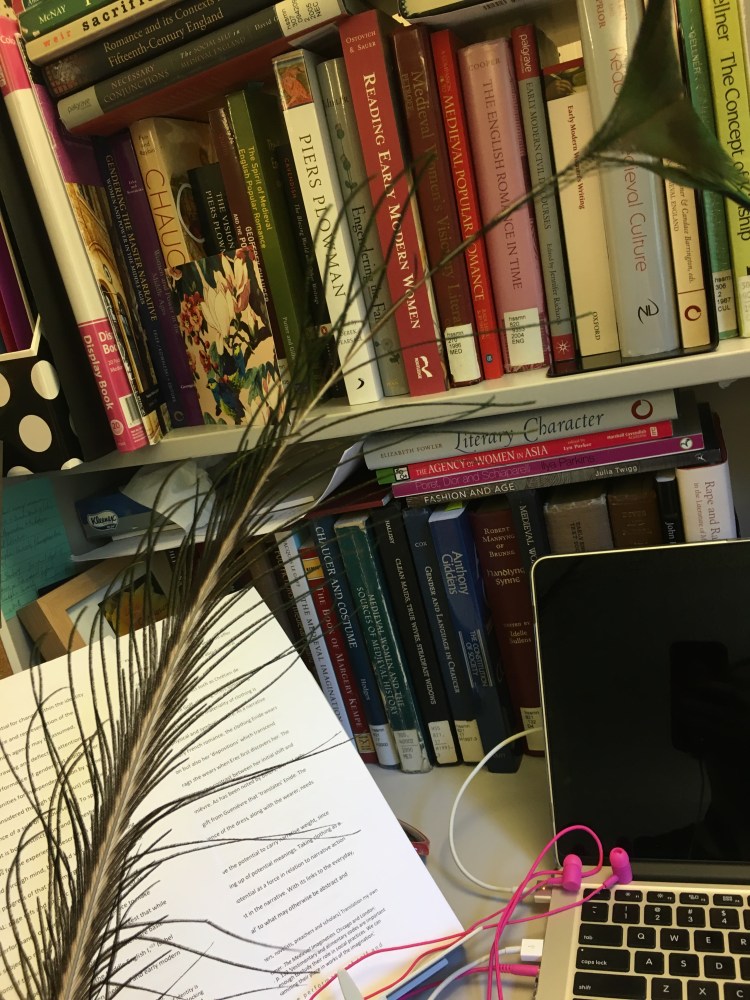
Peacock tail feather resting in front of desk
A writing nest

I share my uni desk with another part-time student.  I suspect the scrap would have been safe if I’d left it on that desk.

*It was also unnecessary. I didn’t end up posting the photo.

Poetry in film – January – Bright Star

As far as tangents go, I’m liking this poetry-in-film ‘project’. It offers time out but also structure. The fun part is that I can share the films with friends and family, but not necessarily the poetry. This is an important point since not everyone in my world is a fan of poetry. Here is potential for a spot of poetry by stealth.

Stealth poetry. It could be my new thing.

I can’t say that I’ve made a great deal of progress exploring Keats as a poet. I don’t often work with strongly rhyming forms and I can find them a challenge to read.* Yes, I know. This is odd given many of the texts I’m working with for my research … That said, I’ve dipped into the new volume I picked up at my fave secondhand bookstore and I’ve cruised around some websites.

With this being as far as I’ve gotten, my position in relation to Keats is going to have to remain as peripheral for now. What follows is, therefore, a general reaction rather than a considered comment.

A toe in the water

In my reading around the place I came across some observations about Keats being an uneven poet and from my toe-in-the-water effort I can see how this would be true. There are poems that just don’t work for me (‘A Song About Myself’ comes to mind even though I can see that there is a progression in there which I might enjoy looking at at a later point) but others are beautiful. I enjoyed the repetitions in ‘A Prophecy: To George Keats in America’. ‘On First Looking Into Chapman’s Homer’ is a favourite, as is ‘Ode to Autumn’.

I remember attending a talk on ‘On First Looking Into Chapman’s Homer’ and feel I should hunt out my notes from that day. Unfortunately, hunt in this case is not a euphemism. I can’t remember ‘when, where or who’ at the moment so I’m stumped as to where to go in search of the notes. I do remember that my curiosity was piqued and I spent some time looking at the poem and Chapman’s Homer for a bit.

(And now, as I write that, I remember what it was that was happening around that time. There was chaos. At least I know which set of notebooks to go to …)

I think the poem that I am most likely to keep coming back to is ‘Ode to Autumn’. As far as an anchor for working through the body of work goes, I don’t think this is a bad choice. I have wondered (idly) whether I might like to write out a copy of the poem to have on a board near my writing space.

Then I think of the state of my writing space and … I turn my attention to other things.

Hello, domestic avoidance.

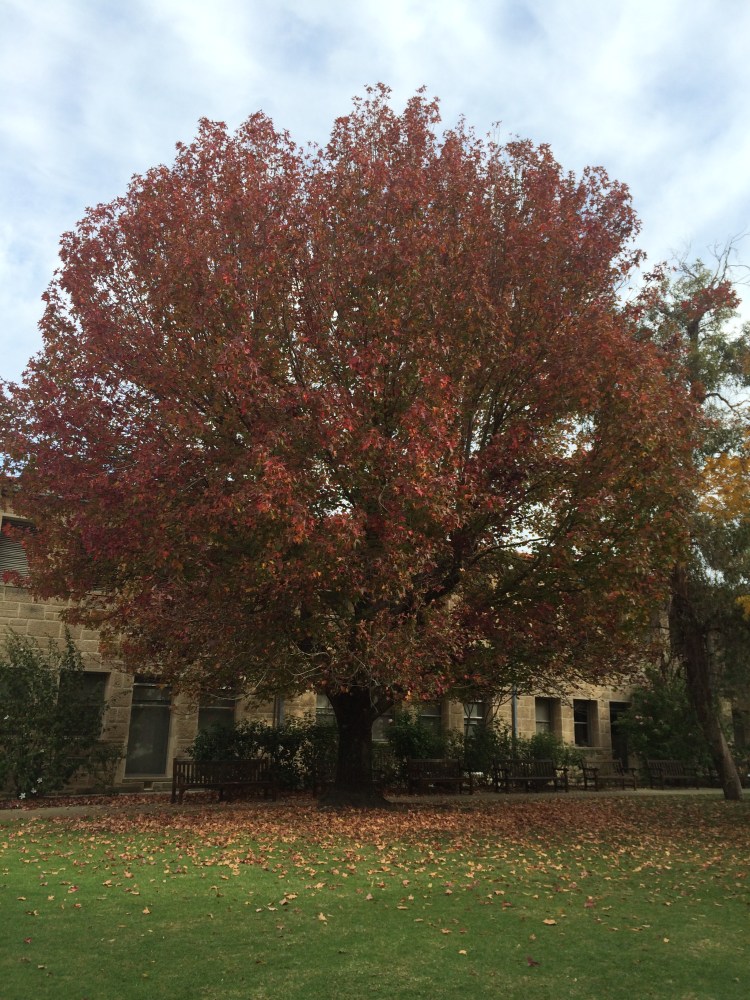
A tree in the Patricia Crawford Court last autumn
One of my autumn memories

Back to the film

Of course, what has brought me to this point is Jan Campion’s film Bright Star. The film is visually lush and I love it. Obviously, there is a fair bit of embroidering on the details of Keats’ life in order to construct a story for a ‘mass’ audience. I don’t mind a bit of embroidery in a film. It isn’t as though I was watching it for a true representation of Keats’ life. If I want ‘the truth’ I’ll find a biography or engage with primary source material. What I found particularly satisfying is that, in a stroke of serendipity, the film has been useful not just because of the pleasure factor of beetling about the place thinking of poetry but also because of one of the narrative’s strands: Fanny Braun’s obsession with (perhaps that should be reliance on) fashion.

My research topic is focused on late-medieval English texts and the connections between clothing and women’s personal agency. I’m starting to build up a little list of films that have statements about clothing/fashion which have nothing really to do with my topic but are interesting in terms of how personal agency is connected to dress. The most obvious of these is The Devil Wears Prada (David Frankel, 2006) but there are some others that I am sure are going to come up at some point.*

In Bright Star, Fanny talks about the connection between originality, or singularity, of dress and how that connects with personality. It comes down to the idea of the making and marking of an individual. In addition, Fanny’s skills in design and tailoring are presented as useful. Clothing, for Fanny, is not the frivolous whim that is dismissed by the character of Charles Brown. Rather, it a statement of self and a practical means of survival. She might make money from her creations but Brown (and Keats) is unlikely to.

Fiction it may be but, as a reflection point, this has been incredibly useful in the past few weeks in terms of considering how modern audiences and readerships make meaning of medieval and early modern texts. I’ve been thinking about the relevance of production and reception contexts – in general terms of theory but also as part of what the forces are that are shaping my own readings and the direction of my research.

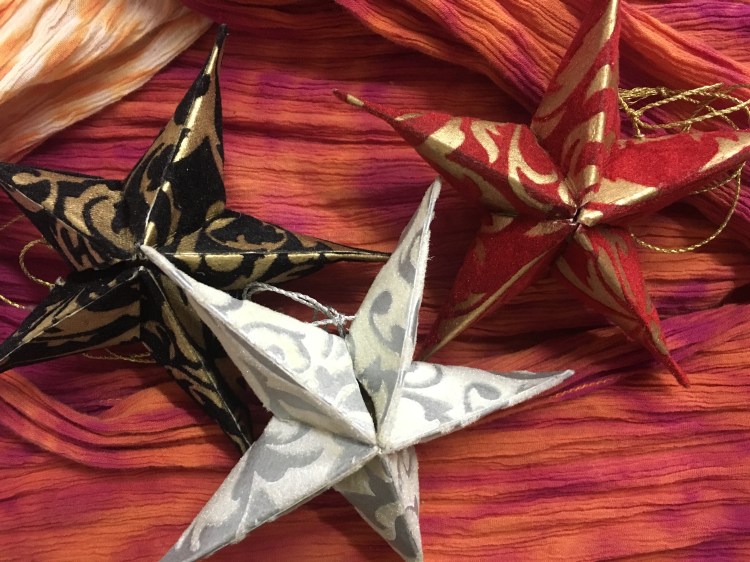
Three scented stars intended as pomanders in place of the picture of the night sky was planning on using but couldn't because, really, where is Perth's summer?
Stand-in stars

*I mention this dot-to-dot connection between recreation and research now mainly as a warning to those in my life who may find themselves participating in research-by-stealth activities when they really think they are just ‘catching a flick’.


The long and the short of it – the usefulness of short poetry forms

When the idea of writing overwhelms me, I remember the beauty of short forms. There’s a part of me that sometimes feels a bit guilty when I do this. Why? It is not as though short forms are cheating.

Putting aside the novels I’ve started and left fallow, the 80 000 – 100 000 word thesis I’m working on sometimes freaks me out. It is not because of the word count but the need for cohesion. The pressure for coherence bears down. Faced with pages of notes and (some rather beautiful) planning sheets I still find myself beset by questions such as ‘can I sustain a sensible argument?’

Now that I’ve worked my way through the first 10 000 words – which I suspect will end up as somewhere more like 5000–7500 by the time I get to the next incarnation of that chapter – I’m feeling more confident that I know what my argument is. Or, at least, what I believe it is going to be so long as I can come up with the evidence to support it.

Short forms

A lot of my writing is image based. This works well for me when I’m working with short poetry forms. I like the way these forms call for a compression of language. Haiku, tanka, cinquains, Ezra Pound couplets are among my favourites. The constraints that short forms impose are comforting.

The example of Pound’s use of the form that comes most readily to mind is probably ‘In a Station of the Metro‘.* I find Pound’s juxtaposition of the human/metropolitan with nature works beautifully. Those two lines do a lot of heavy lifting.

Ages ago – the century was still fresh – I spent some time purposefully working with short forms. They fitted well into my routine. There were one or two poems from that period that I quite liked. One was based on the structure suggested by Ezra Pound couplets…

By the Pound

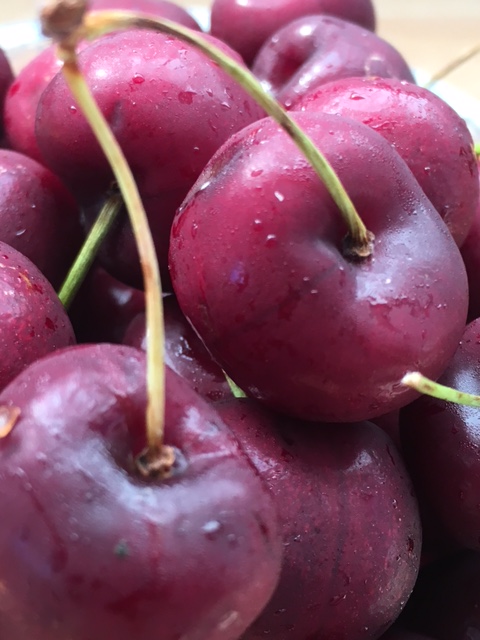
Red cherries in rich globular pairs;
Words arranged in tight bundles.
Lovers entwined on the river bank;
Images wrought with measured breath.

It isn’t just the poem I’ve been reflecting on but how I was able to fit writing into a crowded schedule. Among the short pieces – which helped keep me focused – were some extended pieces, mostly short stories, that were cohesive (even if not always coherent…I need to remember that I might achieve one without the other). Writing fed into writing that fed into more writing. It was a case of filling the well to be able to draw from it.

The bigger project

For the past few weeks I’ve been revising the draft of Chapter 1. I’ve also been reworking the (beautiful) plan I had drawn up for the shape of the whole thesis. My ‘super symmetrical structure’ has shown itself to be nothing but a dream. The whole approach has changed, too. I should also be well into the second chapter. I’m not.

Looking back over the work I handed in I can’t help but see that I need to be careful with how I use images. Perhaps I shouldn’t be using images at all. I know I can’t mix metaphors in the writing (which I have done terribly in a couple of past essays…) but I do want to use some images in the course of the discussion. I like writing with images but I need to keep them sharp, especially in the context of academic prose.

The discipline of short forms needs to come into play in my extended pieces of writing. While aiming for the 80 000 words, I need to keep control. The language needs to be compressed, ideas well focused. Images might help express the ideas. While it could be fun, it is probably not appropriate to slip a haiku or an Ezra Pound couplet masquerading as prose into analysis and commentary.

Not only do I need to be making use of the discipline of short forms, I think I should be working with them. I have three reasons for this:

  1. I need to working on practicing concise language and compressed images.
  2. It is good to have a routine (and expectation) of producing contained objects.
  3. I find short forms can be effective memory keys.
Fresh cherries in a bowl
Sweet cherry pairs

The plan evolves

I think there is space to integrate short forms into my daily practice. Not as an add-on but as a part of the work that I’m already doing. Page after page of bullet points and flow charts have not been working that well for me. A few haiku and cinquains might be just the ticket. They can unlock all sorts of emotions and ideas in ways that are much more effective (for me) than straight notes.

Notemaking just got a whole lot more creative, and fun!

*I have no idea of whether he thought specifically of these as a form, and that’s a research rabbit hole I’ve no intention of tumbling down. I must not tumble down that rabbit hole…

Blue skies – writing and the pleasure of simple things

I’ve had a great week, even if the weekend did get away from me. There wasn’t a lot of time for blogging but plenty of writing nevertheless.

It may not have been quite the writing I wanted to do but it was writing that I’ve needed to do.

I guess you could call it survival writing? Or, perhaps, utilitarian? Work-a-day?

More on that another time.

Perhaps. I’ll have to think about it…

What does stand out for me about this past week – and what I’ve been wanting to sit down and writing about all weekend – is the awareness of the pleasure there is in simple things.

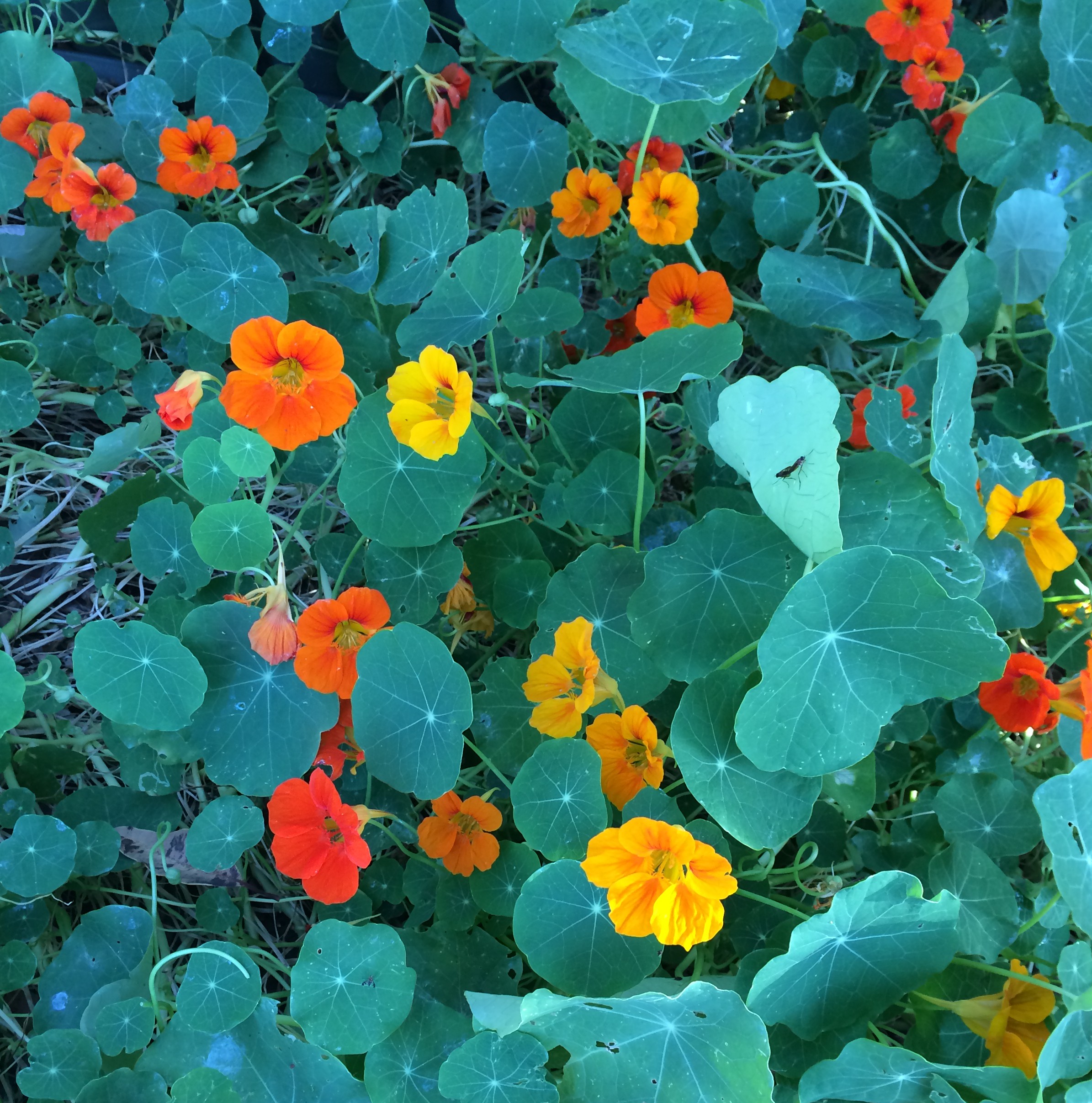
Yellow, orange and red nasturtiums
Spicy nasturtiums

Spoken words

Monday featured a lecture at uni and Voicebox in Freo. I’m not a fan of double-booking and I admit I was a shade late getting to Voicebox but it was worth making the effort to get to both events.

I slipped into that dim room just let the words flow over me.

Arriving late meant that I missed part of the opening set, presented by Siobhan Hodge. I would have liked to have caught it all. Carol Millner and Randall Stephens were both wonderful.

The memory of some poems are still with me. One of the open mic in particular stands out.

It was Annamaria Weldon’s ‘My Father’s Ikons’ was mesmerising. The room was hushed and still. The images that ran through the poem were just beautiful.

 To be held in thrall by the spoken word is exquisite.

I can’t find the notes I made at the end of the evening. I expect I’ll come across them tomorrow. When I least expect it. In an unlikely place.

It is always the way.

The right place

My other joy for the week ties in with study.

It has been a week of making progress and I was just happy to be working through ideas and making plans.

I’m not sure whether I’ve shared previously about how good it feels to be on track with the project. After prevaricating for a bit after finishing my Masters last year I’ve been a tad nervous.

I  figure that new actions and directions can be unsettling at first.

Settling back into a formal study routine has been tricky. I’m aware that I need to tweak my schedule. My environment is still not quite right.

All that taken into account, the ideas are starting to take shape and it is exciting.

I’ve asked my friends and family to remind me that I was this blissfully happy when I start to moan about how hard it all is and ‘no, I don’t want to talk about my thesis’.

I’m sure it will happen. It must be inevitable.

Friends seem at pain to regale me with horror stories about the process.

For now, though, for now it is a balm and I feel blessed and I can’t wait to get back to the books tomorrow.
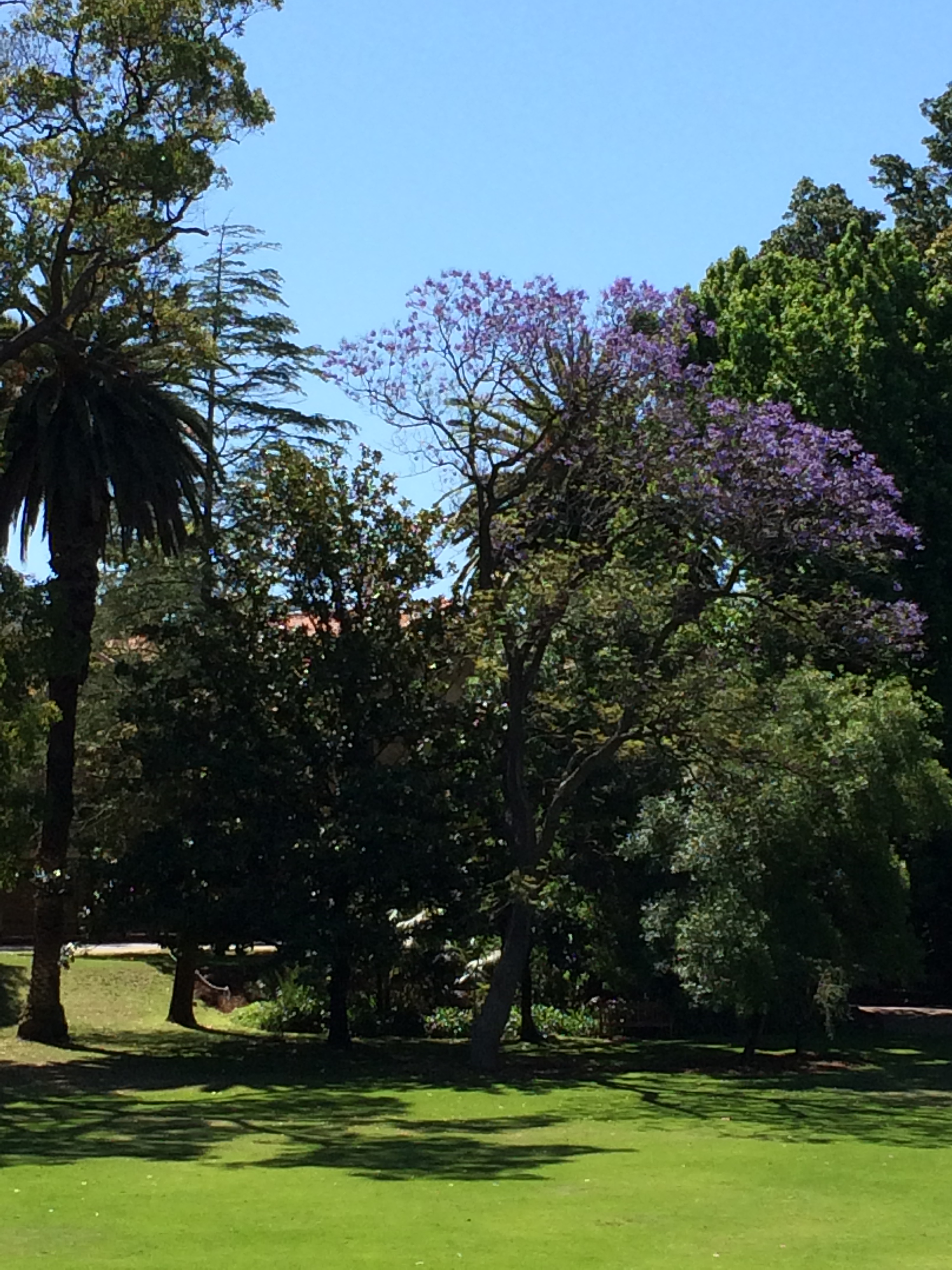
A blue sky behind a jacaranda
Blue skies above

*But first I need to sleep. When did the clock tick past midnight?

A trio of lectures – feeding my mind, filling the well

Deadlines are coming at me from all directions. They’re flying in thick and fast … and there’s no dodging them.

I’ve been a touch frantic in the past week. This, perhaps, explains how a whole mug of tea ended up on the study rug rather than by the computer. Perhaps.

As I’m not known for my coordination, it is possible the rather promising brew was always doomed.

The present collision of deadlines is unusual.

I am no stranger to the intersection of a few due dates but the current fortnight is a doozy.

My response? Set-up to-do list, remember that fretting about timelines makes me tetchy (sorry, loved ones), catch up with friends, remember to enjoy the sunshine and fresh air, sit on a couch by the window in a favourite cafe and write while waiting for an appointment,* take in a few lectures.

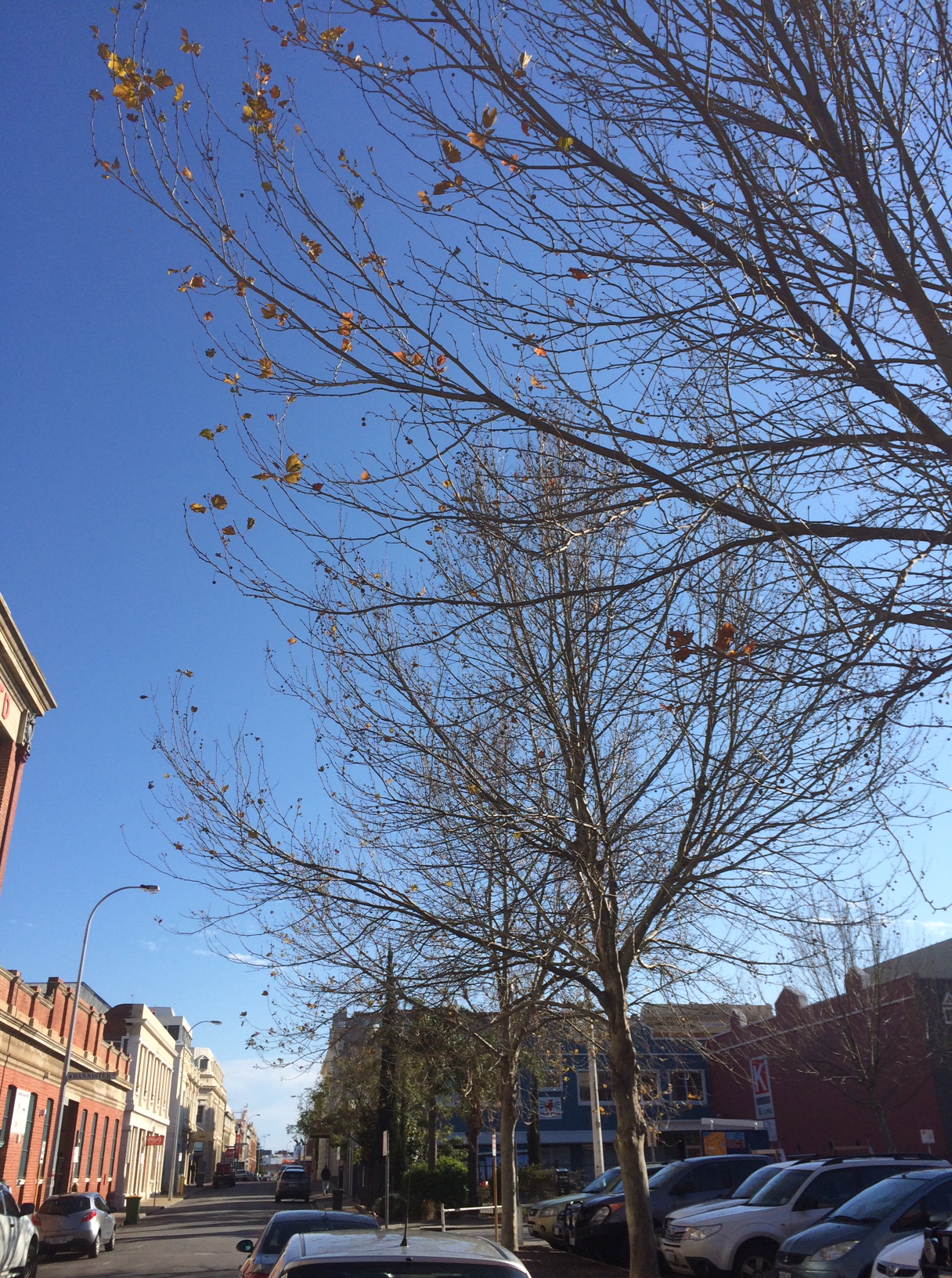
Pakenham St trees
Remembering to enjoy the sunshine

Why? Breaks that require me to stay alert and give time for reflection and planning are more helpful than simply ‘switching off”.

I find that if I choose television as a break activity I struggle to get back to working effectively. Engaging with other people and ideas creates space between one set of tasks and the next. So does the processing time that driving across town allows. I gather I’m not alone with this.

The bonus: once I’m on campus I find I am ready to focus and I tend to be quite productive. I think I’ve made that observation previously.

It was tricky, but I made it to three lectures this week. I’m glad I did.

The Bodleian and the First Folio of Shakespeare’s plays

Wednesday was Pip Willcox’s talk for UWA’s Institute of Advanced Studies: ‘for Harry, England, and … everyone: the many lives of the Bodleian First Folio of Shakespeare’s plays’. Pip Willcox is Curator of Digital Special Collections at the Bodleian Libraries, University of Oxford. She gave an account of the Bodleian’s ownership of a specific copy of the book, the physical features of the book, and the project to digitise the Folio.

It’s probably no surprise that I’m a book geek. I find the history of books as objects – and the history and process of creating books – fascinating.  I wanted to make it to the lecture as soon as I saw the abstract. The story of this particular copy has drama and intrigue. I wish I had time to go into the details.

The digitised product Willcox was speaking about looks to be a wonderful resource. The project website is still available at http://shakespeare.bodleian.ox.ac.uk and the digitised version of the folio is available at http://firstfolio.bodleian.ox.ac.uk. I can’t wait to have some free time to get in and look around properly.

Bresnick on Blake, Goya and Kafka

Thursday brought another presentation sponsored by the IAS featuring the composer Martin Bresnick, Professor of Composition, Yale School of Music. The title of the talk was ‘Listening to Images, Hearing the Text: new music that engages the visual and the literary’.

Bresnick spoke about his work as a composer – particularly in relation to the development of his multimedia piece developed from ‘For The Sexes: the Gates of Paradise’ by  William Blake and his response to Francesco de Goya’s ‘Caprichos Enfaticos’.

The evening included a live performance of ‘For the Sexes: the Gates of Paradise’ by Lisa Moore. The combination of music, spoken word and a projected animation of Blake’s illustrations of the poem was intense and visceral. It left me wanting to go back to Blake and read more by and about him. I’ll also look out for an online version of the multimedia piece. Not just yet, though. I need time and space for that.

The recorded  extracts from ‘Caprichos Enfaticos’ were powerful, and disturbing. Again, I want to go back to look at the full piece. That will definitely be down the track.

There wasn’t time for a performance of the third billed piece, on Franz Kafka’s ‘A Message from the Emperor’ but Bresnick’s account of the piece was intriguing. Something else to look into … again, at a later date.

Qaisra Shahraz on Building Bridges

The final lecture in the trio was an author talk by Qaisra Shahraz on ‘Building Cultural Bridges through Literature’ that was sponsored by the UWA Centre for Muslim States and Societies.

Shahraz moved to Britain from Pakistan when she was nine. She writes novels and has a commitment to building bridges, using literature to celebrate diversity. Identifying as as British, Pakistani and Muslim, Shahraz spoke about how each of these identities is important to her as a person and a writer. Reading from her novels, she shared a world that is alien and familiar.

This third talk came as a welcome change of pace. Making the dash from work to uni didn’t appeal and I was tempted to cut my losses and head home. I’m glad I braved the freeway at peak hour.

I walked away with a copy of her first novel. I’m afraid it will linger on my shelf before I get a chance to read it. I will want to take time and not be distracted by other things.

Even if I’m tempted … I must resist for at least the next few weeks!


Playgound
I need time to play

*The window in question for this particular post was at Bread in Common. On Saturday morning the sun was streaming in, the sky was clear. It was perfect for writing and working out a plan of attack for the weekend and the week ahead.


A week of bookshops, mooching and poetry – my readerly-writerly idea of bliss

It’s been a busy week. There has been oodles to do with family, work and study. I may not have been productive as far as outside-of-work writing goes, but I’ve been busy. It’s been good.

I’ve taken a break from the scrawl. Also, I’m nearly done with the jottings I can find in notebooks. This is not to say more notebooks aren’t lurking. My study is chaotic and I suspect that not all the notebooks were in there in the first place. That said, there’s only so much backwards looking I can do in one hit.

Note to self: it might be good to read some of the books on dealing with clutter that are taking up space on the book shelf.

Despite not much to show for it, I’ve been showing up at the page a bit. When I’ve done so, I’ve made a conscious effort to keep the writing on loose leaves. That way I can avoid adding to the scrawl I’ve been working so hard on clearing.

While there’s nothing substantially ‘useful’ in these latest pages, a few lines here and there look as though they might be worth mining for later. I’m happy with that.

Late in the week I found myself writing in cafe. I got so caught up I lost track of the time and was nearly late for a conference/seminar.

I have to admit it’s been a while since I was immersed to that degree.

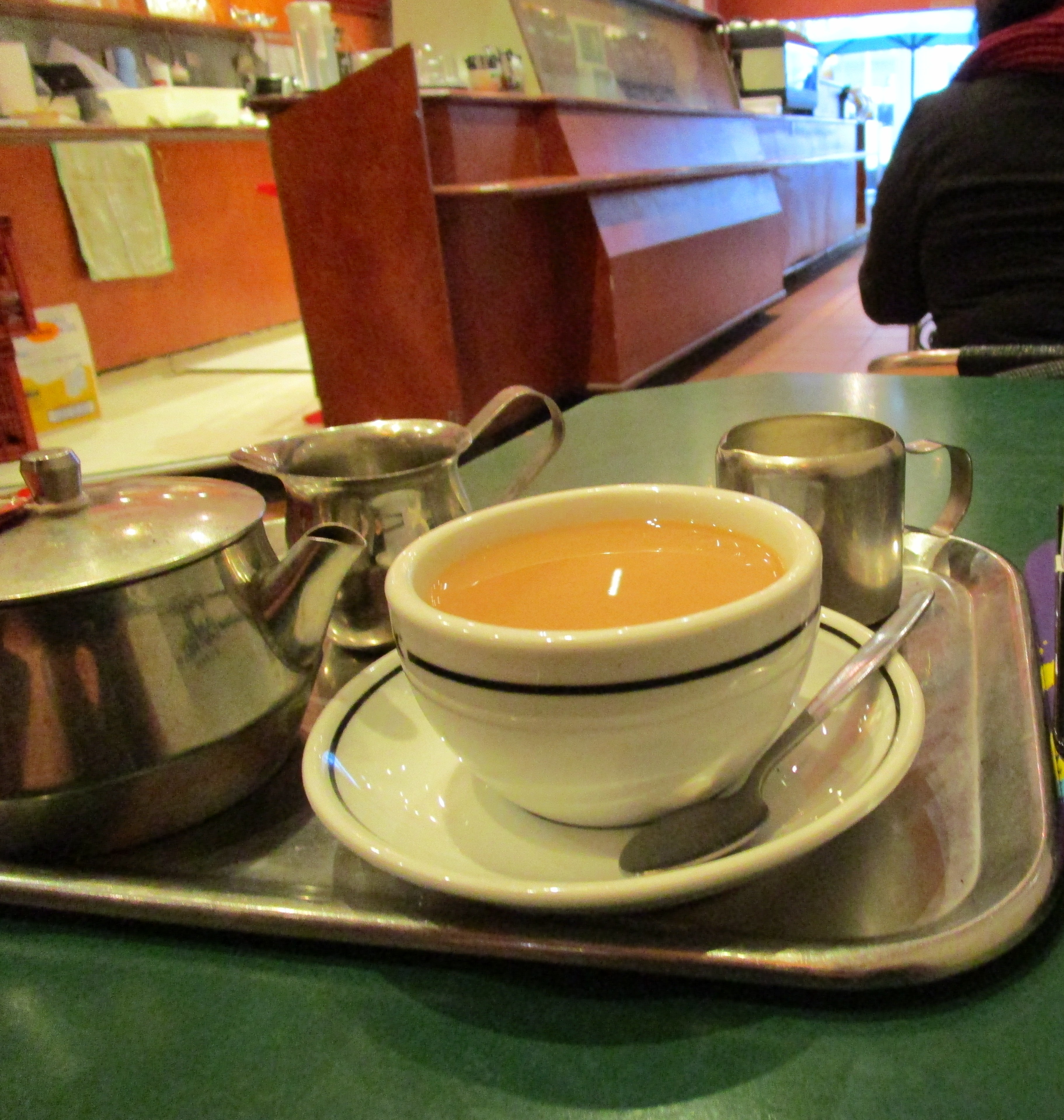
Photo of poured tea on a metal tray in a city coffee shop
I managed to find time for some cafe writing

Mooching around bookshops

Saturday was a cracker. I made it to not one but two bookshops: New Edition Bookshop (Freo) and Bookcaffe (Swanbourne). I was tempted to make it three when I went to go to the library –  the Coop (UWA) – but I figured I had some work to do.* I kept myself to just the two.

I’m excited that NEB is back. There’s been a bit of an hiatus while they’ve been moving premises. I don’t know what the full story is but I’ve missed them while they’ve been away. I know ‘they’ are a different ‘them’ but I’m sure you get my point.

I like mooching about Freo. I love mooching about Freo going from bookshop to bookshop. That’s been a tad tricky in recent times. The Freo bookshop count is generally in decline, NEB hasn’t been around and my mooching opportunities are decidedly outside working hours.

Swanbourne isn’t too far from Freo. I zipped up the coast to catch up with a friend on my way to uni. Books, chatting, hot chocolate, sitting by the window. It was lovely.

One of the books that made its way home with me is My Brother’s Book by Maurice Sendak. It is a beautiful, meditative riddle. I don’t feel as though I’ve managed to nut-it-out and I need to spend more time with it. I’m not sure when that will be.

Poetry night

Monday was great because it was, as we say in my family, ‘poetry night’. Yes, I made it to Voicebox again. This is starting to be a habit.

There are worse habits.

Again, I enjoyed all three guest poets. I’m afraid the titles have escaped me but Dick Alderson’s poem about almonds, Dennis Haskell’s about oranges and Kylie Stevenson’s about Deep Water Point all stuck me at the time as beautiful explorations of imagery and emotion and they’ve stayed with me for the week. Rose van Son’s ‘Meatworks, Caversham’ is one of the poems from the open mic readers that keeps coming back to me.

I’ve been thinking not just about the poems that were read, but the usefulness of poetry for narrative . The distillation of words and ideas carries an emotive power for telling story that I find visceral. A bit further along from these thoughts is how much I enjoy the poetic within prose.

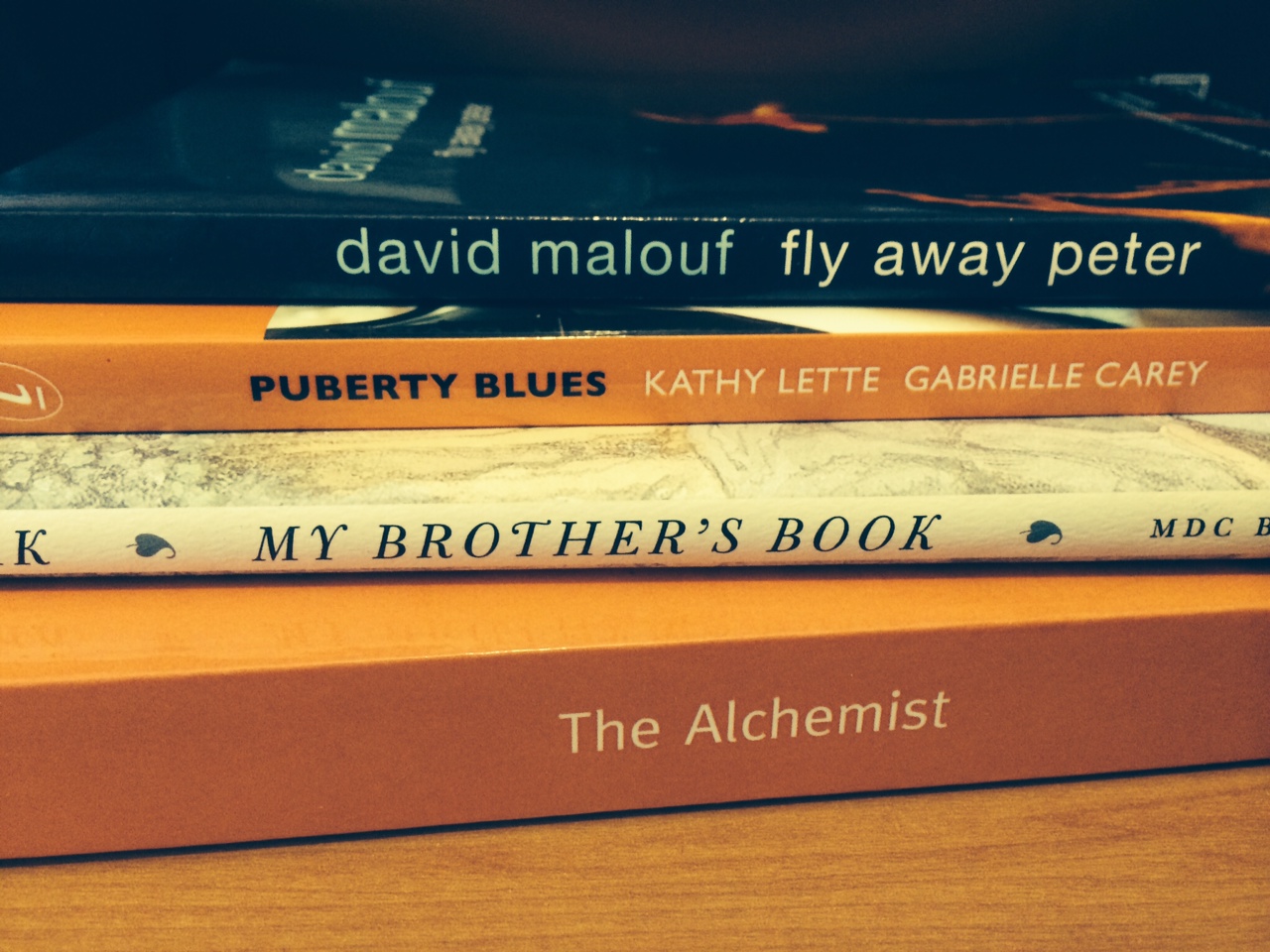
That’s led me on to reflecting on novels that I read as poetic. Yesterday I picked up a spare copy of David Malouf’s Fly Away Peter so I could dip into it on the train ride home for precisely that reason.

In the end the train station was a shade too hectic for the way I wanted to read the novel. Instead, I started the copy of Ben Jonson’s The Alchemist that I picked up from the same sale shelf.

A stack of books
The outcome of bookshop mooching

I now find myself with two copies of Fly Away Peter. Possibly not the best outcome for book-case space crisis of 2014 (which is very much like the book-case space crises of 2013, 2012, 2001…1975 – when I was given my first bookcase for my birthday…) but that particular thread of thinking – the poetic in prose – is always tantalising. I hope I can hold onto it in the face of a week which, I already know, is going to allow very little time for musing as such.

*I didn’t go into the library either to be honest. I sat in the sunshine while I looked for useful articles online. Being able to work remotely is such a bonus.

On the fly – what happens when ideas slip away

I find myself at a loss. There is no excuse, really. I’m at Public and Co, in South Freo. It’s comfortable. The music is fun. As a found-space for writing, it is perfect.*

Yesterday, I knew precisely what I was going to write for today. It was a glorious day on campus. The sky was that blue you get on a warm, clear day in winter. The air was crisp. I remember the weather and where I was as I thought ‘yes, that’s it’ (I was passing the Oak Lawn on my way back to Arts before heading for the Club). The idea has evaporated.

The story of my life. Ideas come and go. If I’m lucky – i.e. sensible – I make a note. Often, I just get caught up. As I move on to the next thing I let go of an idea to take in something new.

So, here I am. My Saturday posting is a self-imposed and arbitrary deadline. It only matters because I’ve decided it does. There’s no other reason. Still, I need to meet it.

I remember the air was crisp.

Chaucer to Manson by way of Coleridge

Earlier this week, I found myself in front of a (thankfully small) group of strangers. I needed to give a presentation and I hadn’t prepared. There had been some confusion and I wasn’t sure I needed to … I should have. Being prepared is always helpful. I had said to my colleague that I would probably talk about poetry. When the moment came, poetry was what I latched onto.

I was lucky that I have been thinking so much about poetry of late. The other topics in my sights at the moment are women’s agency in late medieval and early modern English writing, impoverished knights and the experience and expression of shame – again late medieval, style guides and project plans. Looking at it, poetry was the friendly option.

I had tried a couple of times to make some notes. Nothing I came up with seemed to be at all promising. I had rehearsed some ideas – in a vague way, unable to settle on any form or content. I hadn’t written anything down.

In the flurry of the introduction and no knowing what I was going to talk about I launched into storytelling. I took my audience on a whirlwind ride. I remember I began with a joke – which I worried may have been inappropriate but couldn’t stop to check or apologise for – and I headed to Coleridge, his mariner and a funeral for a pen in a Literature class when I was in Year 11. I zipped backwards to Chaucer and I ended with Marilyn Manson.


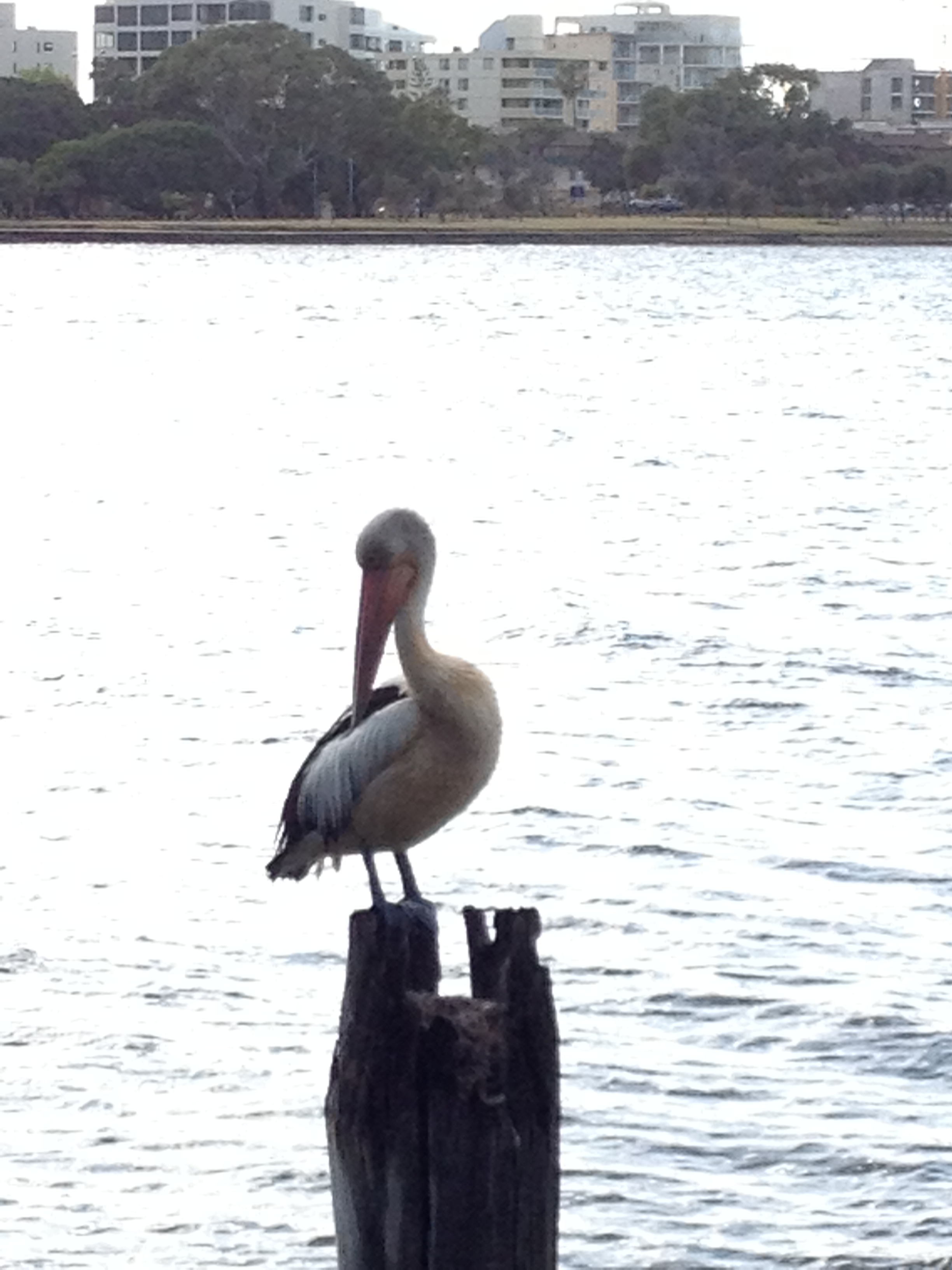
Pelican on jetty pylon
A standing pelican (in the absence of an airborne albatross)

I’m not entirely sure what I said – or how I got from one poet to the next – the whole thing  is a blur. I know I mentioned haiku and Ezra Pound couplets. I think I spoke for 5 minutes. I’m not sure what my time limit was.

I’ve told the funeral-for-a-pen story before, I’m pretty sure I know how that bit went.

Luckily, they laughed with me

I dread speaking in public. I used to speak quite a bit but I don’t do it that much these days. The further away I got from regular presentations, the scarier they became. It makes sense to me – more or less.

Apparently the talk this week went ok, though. While I can’t remember precisely what I said, I do remember that the audience laughed. I like it when that happens. Well, when an audience laughs with me. That’s quite nice.

The timer had flicked the panel of lights from green to amber. I knew the switch to red had to be on its way. I realised I wasn’t sure of the rules. Did I need to finish before the red? Was it ok to finish on the red? That’s the moment when I really began to panic. I was trying to find a way to finish off. That’s how Marilyn Manson got pulled into the whirlwind. It was a straw I happily grabbed at. It pulled everything together. I think. I trust.

It would be nice to remember what I actually said. It would be helpful to remember what the evaluator said. The words, like so many ideas, have evaporated.

I do remember that it felt good when the next person stood to speak.

The habit of over-thinking

So, where do these musings fit?

It’s not just that I’ve forgotten my initial idea. Nor that I mourn that it has escaped my grasp. I’m sure it will come back to me. At an inconvenient time. Probably the dead of night.

In the meantime, I have been thinking about the role over-thinking plays in my writing. There are areas where I think I just need to let some of go. While I don’t think unprepared talks are necessarily advisable, my Coleridge-Chaucer-Manson talk from this week probably worked because I just launched into it.

The imperative of getting to my feet and getting the words out meant that I got the talk done. Could it have been better? Probably. Would it have been better with drafting and rehearsal? Possibly.

Where it was tempting to over-think, not thinking (as such) seems to have had its merits. That’s something to think about.


*I have no intention of writing about food on this blog. It isn’t really my ‘thing.’ BUT … as I wrote this I indulged in an early lunch that took the form of a very late brunch … wild mushrooms done in sherry butter with really crispy bacon and toasted ciabatta. Wow.


A familiar dance – processing time is not always procrastination

My desk is tidy. Well, when I say ‘tidy’ I mean the half of the L-shape that is devoted to ‘technology’ is organised. I’ve washed and dried my hair. I’ve made my fingernails look a little less ragged. I’m about to finish my third mug of tea for the morning.

This is a dance I do. It would be quicker if, like the dog, I could just turn three circles, sit myself down and settle into the business of the day. For the dog that business is dozing. For me it is a to-do list.

This weekend’s general list includes emails, start week one of a mooc – before week two arrives, read articles for a research project, draft some notes for a talk I said I would give, complete essential chores, ignore non-essential chores, spend some time with family and friends, go for a walk  – preferably by the river where I’m confident there will be pelicans and I’m hopeful there will be dolphins.

Striking through

I do like crossing off items as they are done. It works for chores, projects, ideas that are acted on. I’ve been able to pull a couple of cards from my projects list in the past few weeks. They were among the smaller projects but it still feels good to have moved them to the ‘done pile’.

I also like to cross through titles in lists, verses in stanzas and paragraphs in prose. I can end up making a fair mess of any given page. For the most part, I’m comfortable with some untidiness on the page. There comes a point, though when too much mess becomes too fraught.

Making space

My mini-project of revising old notebooks – the scrawl I mentioned a couple of weeks ago – is in full swing. Putting sentiment to one side, some of the scrawl must give way. Space is at a premium.

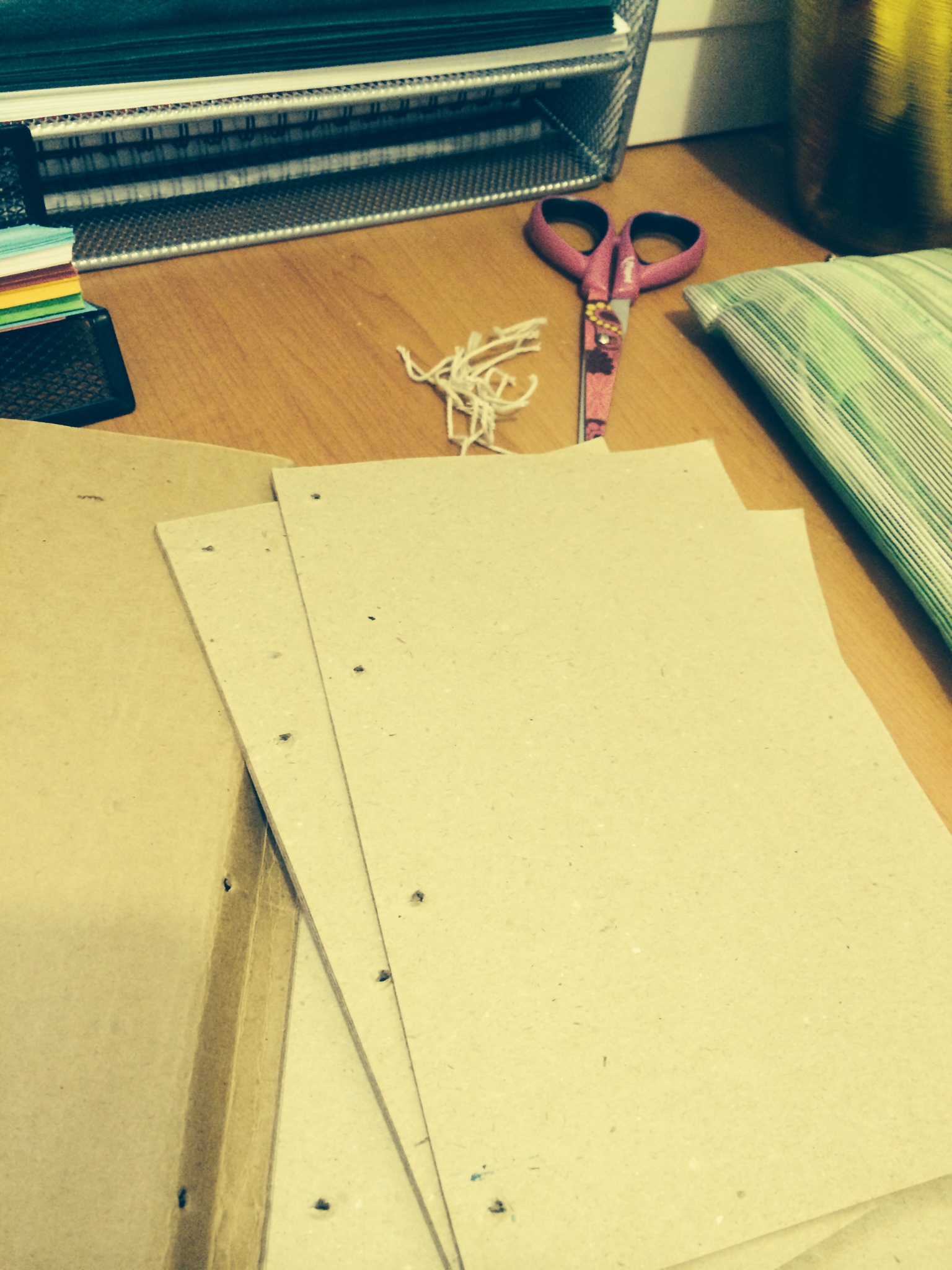
The focus of today’s attention was made of recycled paper bound with string in a corrugated card cover. I liked the book when it came to me, but it has its quirks. The threading on the spine makes it hard to keep open. The texture of the leaves entices. It promises more than struck-through notes and drafts. I’ve always been aware that I didn’t choose as wisely as I may have liked when I started out with it as a place for early workings.

One draft is dated ’98, so this book has been hanging about for a while. All but one of the notes in this particular notebook have been acted on. Most of the worked on pages have been folded to show they are finished. On balance, I have to admit not that many pages have been used. I’d like to start over with it. I think the remaining leaves can be repurposed.

Old notebook made of recycled paper with corrugated cover
Step 1: Initiate
struck through pages
Step 2: Check
ready for reuse
Step 3: Repurpose

Repurposing and renewing

My habit of making lists and roughing out brainstorms of ideas is a useful strategy. It makes for wonderfully productive days. This was especially the case when I worked as a teacher. I had a holiday routine that involved reviewing the lists and notes I’d made during term. If pieces of writing weren’t finished I’d work on drafts and commit to finishing things off. Not all holidays allowed for the routine to be evenly productive but there was certainly a rhythm to the process that helped it along.

I’ve had to modify the way I approach lists. Sometimes there is too much time between the note of the idea and the point of writing. Well, too much time in being up to pick up with the reason for making the note. Sometimes they just have to be repurposed. At at other times, the note is as vivid as when first written.

Looking through a poetry file today, I saw a poem I finished in 2001. It’s ok but not for sharing here. The point about the poem (‘Faithless’) is I first noted the opening line in my first year teaching. That was 1992. In the years between the note and the poem there was little shift in the intent of the idea I hoped to explore.

Other ideas and images need to sit for a while – steeping like tea – before they are ready for use. There’s nothing worse than tea left for so long it becomes bitter and unpalatable. That said, even stewed tea is good for the roses.*

A rueful acknowledgement

I can be quite precious about notebooks. I let them kick around for decades, long enough to end up looking tatty and disreputable. I don’t often attack them with scissors. This poor stablemate was doomed from day one. Happily, I think it has a promising future now it is free of its binding.

I’m sure the next notebook taken from the scrawl for review will fare better. In fact, I doubt many of the notebooks in the scrawl would do as well if I attempted to repurpose them.

*Ooh. There’s a poem there. What luck!