Poetry in film – a quick update

I finally caught up with watching O Brother, Where Art Thou and loved it. I was blessed that a friend volunteered to watch it with me. She cooked chicken, I bought salad. (It is generally understood and accepted that if I’m bringing something for the table I’ll be picking it up on the way.) Sharing the viewing wasn’t something I had planned when I thought of this project.

With all the other reading I’ve had on the go lately, I hadn’t had time to review The Odyssey in the detail I would have liked. Instead, I resorted to rustling up some quick searches on my tablet as the DVD played. I figure that since I went through a phase of watching the movie a lot a few years ago (scenes and dialogue memorised, etc.) I wasn’t interfering with the viewing process.

Not too much, anyway.

On balance

I decided I really do like the looseness of the Coen brothers’ approach to the story. I’d also like to look at more interpretations and spin offs, but I know I just don’t have time. Perhaps when I’m next looking for a side-project it could just be about incarnations of epic poetry in popular culture.

The possibility of it feels so deliciously nerdy.

I can see my reading/viewing list already. I think it will begin with Margaret Atwood’s The Penelopiad (Canongate Myth Series, 2005).* The first film is likely to be 2001: A Space Odyssey (Kubrick, 1968) – because I can’t remember when I last watched it. Certainly not in living memory.

Abundance

I’ve also been thinking there might be a couple of poems of my own that I’d like to work on. (To be clear, I have NO plans to attempt epic poetry any time soon!) Not that I need to add anything more to the to-be-written list. That seems to have been exploding in the past little while. On the upside, I’ve managed to move some titles from the to-be-written to the that’ll-do-for-now side of the ledger.

Getting things written is always lovely.  I don’t mean that as a euphemism. I literally mean that I find finishing a piece of writing to be one of life’s pleasures. It is lovely.

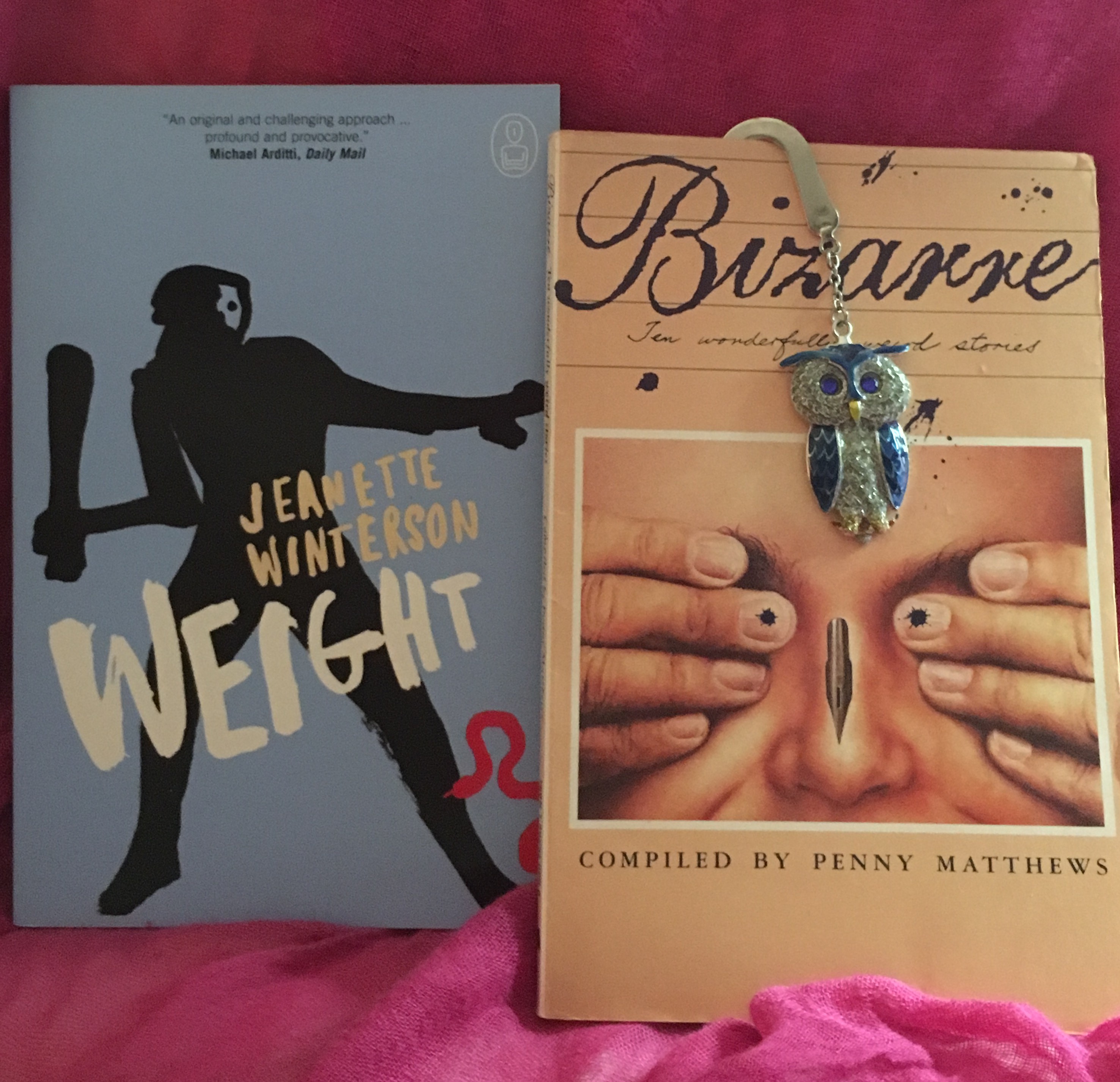
In the meantime, there is a short story that I’ve been meaning to read again – ‘The Owl Boy and the Goddess Athene’ by Gillian Rubinstein. You’ll find it in Bizarre: Ten wonderfully weird stories, compiled by Penny Matthews (Omnibus Books, 1989). I used to love reading it to Year 8s. Such fun!

Reading wakes me up, so now – it’s gone midnight – isn’t my best time to open the book. I think it’ll be a goer for when the alarm goes off in the morning. So long as I get to sleep soon(ish).

Before I go

Next up on the poetry-in-film plan is

  • March Jabberwocky (Terry Gilliam, 1977)
  • April The Raven (I’m not sure which version … Charles Brabin, 1915; Louis Friedlander, 1935; Roger Corman, 1963; James McTeigue, 2012)

I think we can safely say, March is going to look a lot like April by the time I sit down to Jabberwocky and I still need to work out which version of The Raven … I’m a shade torn.
Twists on myth quick reads
A couple of quick reads for the meantime


*Jeanette Winterson’s Weight is a part of the Canongate Myth Series. I love it. I cry every time I read it – and I seem to read it every year or so.


Poetry in film – February – O Brother, Where Art Thou?

Yes. I know. It’s March. What happened to February? I still can’t believe it’s gone.

My plan for February was to watch O Brother, Where Art Thou?  by the Coen brothers. The DVD is ready and waiting on a shelf I pass multiple times a day. It’s at eye level and I look at it each time I pass by. I just haven’t been able to watch it.

Despite that, the film and its distant, loose connections to The Odyssey have been on my mind.

In the meantime, my real purpose in this ‘poetry in film’ project (which sounds so much better than distraction, tangent, avoidance strategy …) was to think about the poems. There should be time for the film over the Easter break but I’m going to jump ahead and riff a bit about the poem now.

A late arrival

I came to The Odyssey late. I dipped into it as necessary when I was an undergrad. I watched friends work with it as part of their studies of Ancient Greek. I wished I could fit Ancient Greek into my own program. I couldn’t. I let it go.

I have fond memories of Sunday mornings in the ’90s watching Tony Robinson’s Odysseus, The Greatest Hero of Them All. I loved that. Robinson’s storytelling on windswept beaches and that great grey coat (and was there a red scarf? a pinkish one?) has stayed with me. Rik Mayall’s Grim Tales was also part of my television viewing at this time. I remember there was cracking storytelling from both Robinson and Mayall.

From time to time there were brief excursions into episodes along the way. Links to a short story here, a conversation about Homer/epic poetry/oral traditions there. It would come up – as you’d expect – in discussions about the hero’s journey and archetypes.

I didn’t read the poem in full until I was in my thirties. I still haven’t learnt any Ancient Greek* so I read it in translation – a Penguin Classics edition by E. V. Rieu, D. C. H. Rieu and Peter Jones and the Robert Fagles translation that I’ve realised is missing from my bookshelf and will need to be replaced. (Yay for shiny new copies!)

I read the Rieu et al version at the height of summer, stretched out on the floor very close to a fan. It was perfect reading for ridiculously hot days that stretched into hideously hot weeks.

I loved the unevenness of the narrative line. When I finished The Odyssey I jumped straight to The Iliad. It was that sort of summer.

poetry in film check in february book pile
Ready and waiting

A recent encounter

In the past few months, The Odyssey has been popping up. It could be I’m noticing it because I knew I would be thinking about it as part of the schedule I set myself. One of those, I just bought a red car, now all I notice is red cars scenarios.

The most striking encounter was when I caught The Epic (Finn O’Branagain and Scott Sandwich) as part of this year’s Perth Fringe Festival. That was an hour of whirlwind storytelling that looked at some of the ‘big’ stories from across the world over history. The show included a captivating demonstration of the ripples of the story that continue to be felt. (I won’t go into detail because I’d hate to spoil it for you if you ever get to see it. You never know…)

I had gone to the show because I thought there was a bit about Macbeth (there wasn’t). The Odyssey turning up was a timely bonus.

The Muse and magic

The Odyssey opens with an invocation to the Muse. As it’s an epic poem, I’m guessing that is Calliope. The invocation rests in ritual and the sacred. It also makes sense for the poem as a spoken performance. It not only calls the muse but captures the audience.

The telling of the story begins with an incantation.

Perfect. So much of storytelling is weaving a spell. I love that drawing in – and being drawn in. There is also the appeal of an external (or it could be internal) driver.

The invocations in Homer’s The Odyssey, its companion The Iliad, Virgil’s The Aeneid and in later poems such as John Milton’s Paradise Lost and, with a slightly different  purpose, Edmund Spenser’s The Faerie Queene offer up the poem as something not only created but inspired.

The lit-nerd in me quite likes the idea of reading just the invocations and doing a formal comparison of what they seek and what they offer.

There are all sorts of arguments against inspiration and for the hard graft of day in-day out work, but there’s a part of me that loves the idea of an otherworldly – if not divine (and these days I’m more atheist than agnostic …) – spark as the impetus of a work.

Why not begin with an invocation to a muse, human, divine or otherwise?

Peacock close up
A muse of sorts

*One day I hope to read it in the Ancient Greek. For now, though, translations have to do. After this thesis is done. Latin has a higher priority. And Middle English, for that matter. I’ll be in my 50s. Excuse me while I process that …

Poetry in film – January – Bright Star

As far as tangents go, I’m liking this poetry-in-film ‘project’. It offers time out but also structure. The fun part is that I can share the films with friends and family, but not necessarily the poetry. This is an important point since not everyone in my world is a fan of poetry. Here is potential for a spot of poetry by stealth.

Stealth poetry. It could be my new thing.

I can’t say that I’ve made a great deal of progress exploring Keats as a poet. I don’t often work with strongly rhyming forms and I can find them a challenge to read.* Yes, I know. This is odd given many of the texts I’m working with for my research … That said, I’ve dipped into the new volume I picked up at my fave secondhand bookstore and I’ve cruised around some websites.

With this being as far as I’ve gotten, my position in relation to Keats is going to have to remain as peripheral for now. What follows is, therefore, a general reaction rather than a considered comment.

A toe in the water

In my reading around the place I came across some observations about Keats being an uneven poet and from my toe-in-the-water effort I can see how this would be true. There are poems that just don’t work for me (‘A Song About Myself’ comes to mind even though I can see that there is a progression in there which I might enjoy looking at at a later point) but others are beautiful. I enjoyed the repetitions in ‘A Prophecy: To George Keats in America’. ‘On First Looking Into Chapman’s Homer’ is a favourite, as is ‘Ode to Autumn’.

I remember attending a talk on ‘On First Looking Into Chapman’s Homer’ and feel I should hunt out my notes from that day. Unfortunately, hunt in this case is not a euphemism. I can’t remember ‘when, where or who’ at the moment so I’m stumped as to where to go in search of the notes. I do remember that my curiosity was piqued and I spent some time looking at the poem and Chapman’s Homer for a bit.

(And now, as I write that, I remember what it was that was happening around that time. There was chaos. At least I know which set of notebooks to go to …)

I think the poem that I am most likely to keep coming back to is ‘Ode to Autumn’. As far as an anchor for working through the body of work goes, I don’t think this is a bad choice. I have wondered (idly) whether I might like to write out a copy of the poem to have on a board near my writing space.

Then I think of the state of my writing space and … I turn my attention to other things.

Hello, domestic avoidance.

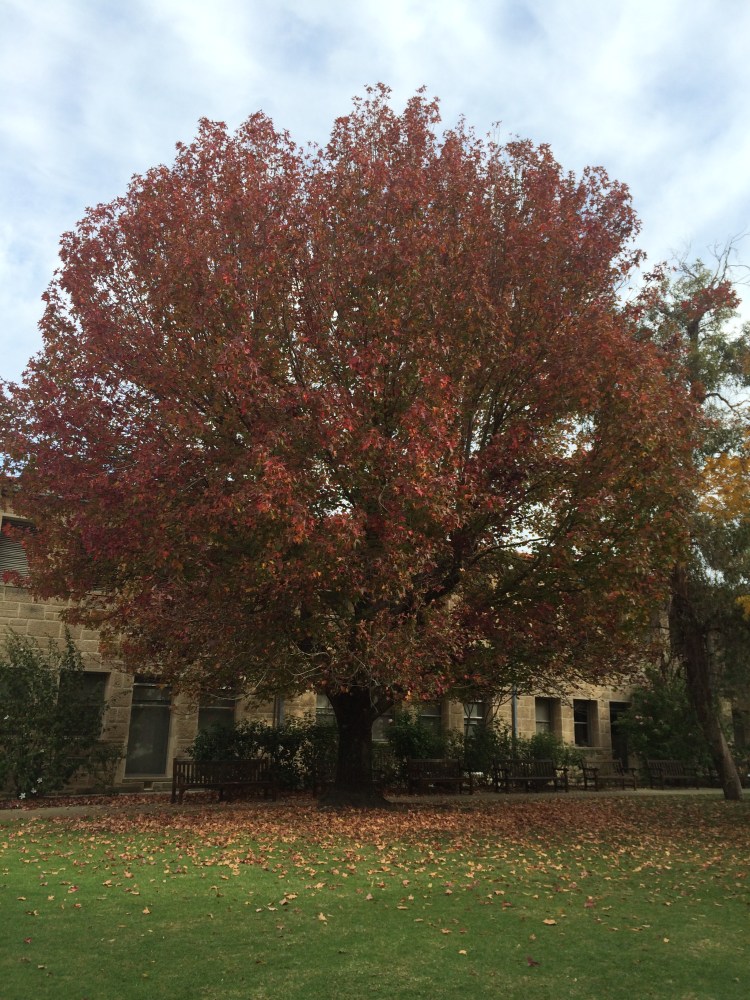
A tree in the Patricia Crawford Court last autumn
One of my autumn memories

Back to the film

Of course, what has brought me to this point is Jan Campion’s film Bright Star. The film is visually lush and I love it. Obviously, there is a fair bit of embroidering on the details of Keats’ life in order to construct a story for a ‘mass’ audience. I don’t mind a bit of embroidery in a film. It isn’t as though I was watching it for a true representation of Keats’ life. If I want ‘the truth’ I’ll find a biography or engage with primary source material. What I found particularly satisfying is that, in a stroke of serendipity, the film has been useful not just because of the pleasure factor of beetling about the place thinking of poetry but also because of one of the narrative’s strands: Fanny Braun’s obsession with (perhaps that should be reliance on) fashion.

My research topic is focused on late-medieval English texts and the connections between clothing and women’s personal agency. I’m starting to build up a little list of films that have statements about clothing/fashion which have nothing really to do with my topic but are interesting in terms of how personal agency is connected to dress. The most obvious of these is The Devil Wears Prada (David Frankel, 2006) but there are some others that I am sure are going to come up at some point.*

In Bright Star, Fanny talks about the connection between originality, or singularity, of dress and how that connects with personality. It comes down to the idea of the making and marking of an individual. In addition, Fanny’s skills in design and tailoring are presented as useful. Clothing, for Fanny, is not the frivolous whim that is dismissed by the character of Charles Brown. Rather, it a statement of self and a practical means of survival. She might make money from her creations but Brown (and Keats) is unlikely to.

Fiction it may be but, as a reflection point, this has been incredibly useful in the past few weeks in terms of considering how modern audiences and readerships make meaning of medieval and early modern texts. I’ve been thinking about the relevance of production and reception contexts – in general terms of theory but also as part of what the forces are that are shaping my own readings and the direction of my research.

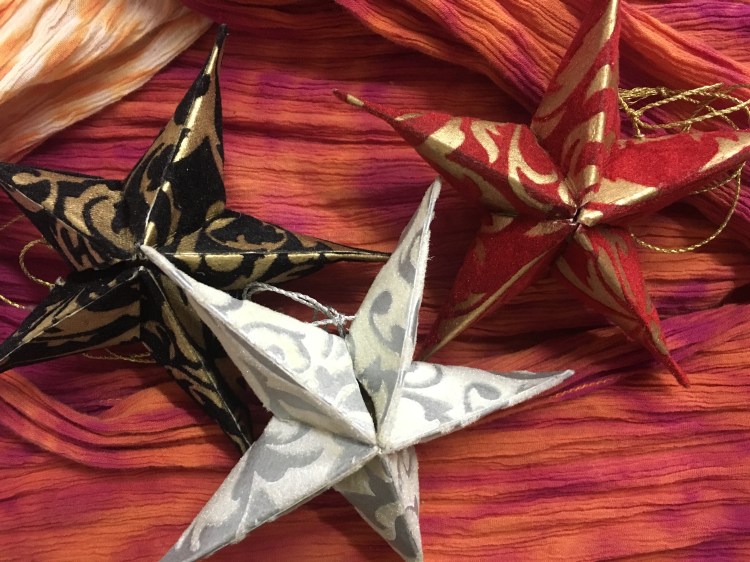
Three scented stars intended as pomanders in place of the picture of the night sky was planning on using but couldn't because, really, where is Perth's summer?
Stand-in stars

*I mention this dot-to-dot connection between recreation and research now mainly as a warning to those in my life who may find themselves participating in research-by-stealth activities when they really think they are just ‘catching a flick’.